Mantic and Thinking Machines post-train a forecasting AI agent, cutting per-forecast cost by 15x
The two companies post-trained Inkling 2 Small on Tinker, achieving accuracy close to Fable 5.2 (medium) and generating 100,000 S&P 500 scenario forecasts
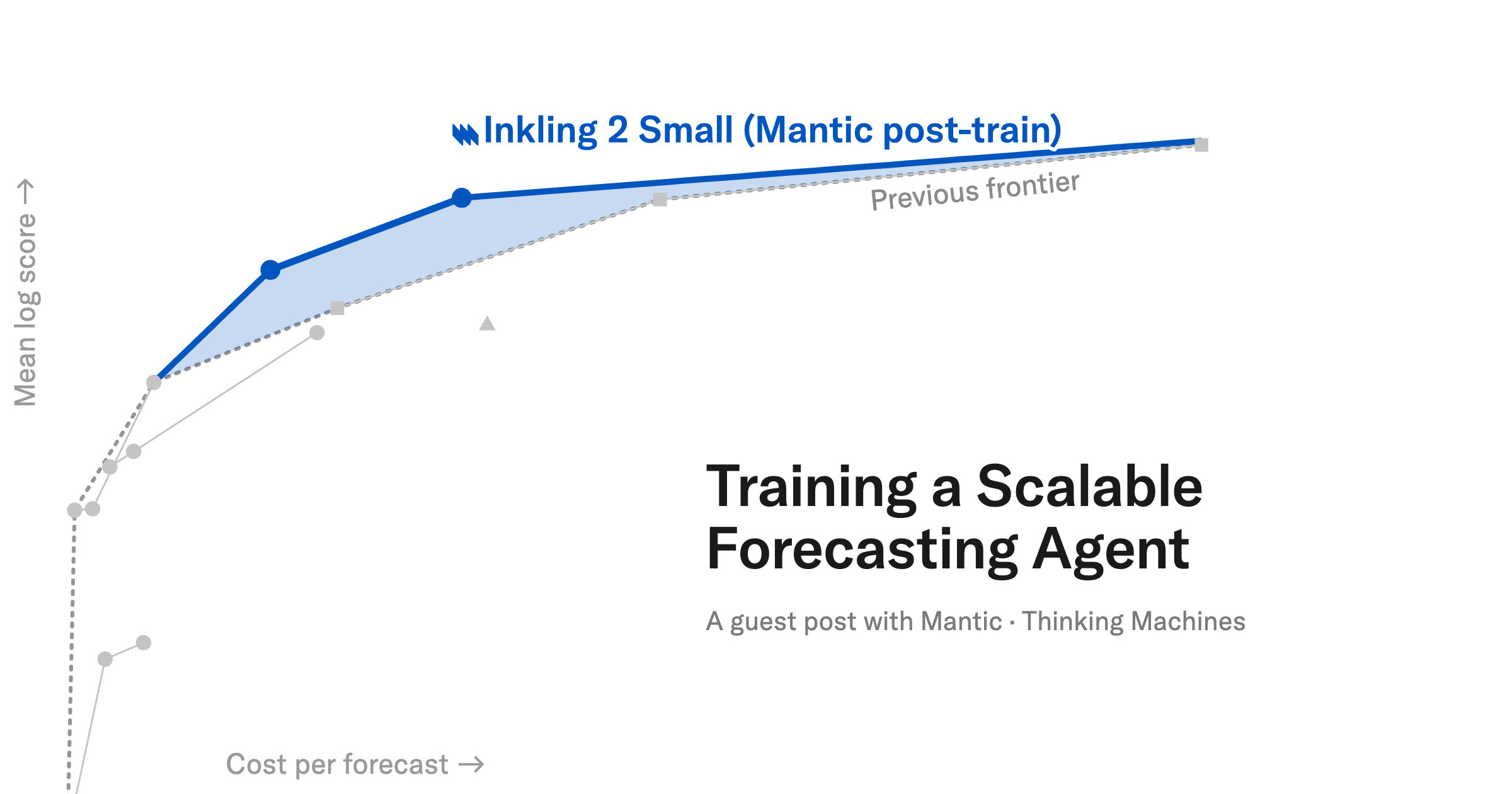
Table of Contents (4)
- 01An end-to-end forecasting agent: from research to probability output in one pass
- 02High-quality forecasting questions are scarce, so synthetic data fills the training supply
- 03Point-in-time data tooling and low-latency infrastructure
- 04Optimizing under noisy rewards: mixing outcome scores with reference expected scores
- Industry Impact & Strategic Takeaways
- Frequently Asked Questions
Key Takeaways (TL;DR)
- 01Mantic and Thinking Machines partnered to post-train Inkling 2 Small on the Tinker platform, building an AI agent that carries out research and probabilistic forecasting end to end.
- 02On 200 held-out numerical questions drawn from Metaculus, Polymarket, Kalshi and other platforms, the agent's mean log score was close to that of Fable 5.2 (medium), while its cost per forecast was roughly one-fifteenth of that model's.
- 03The team built its own synthetic question-generation system and point-in-time data tooling to address the scarcity of high-quality forecasting questions and the prohibitive latency of third-party APIs.
Mantic and Thinking Machines post-trained Inkling 2 Small on Tinker to produce an AI agent that performs research and forecasting end to end, achieving accuracy close to Fable 5.2 (medium) at 15x lower cost per forecast. The agent has already been used to generate 100,000 S&P 500 scenario forecasts.
An end-to-end forecasting agent: from research to probability output in one pass
Results published by Mantic and Thinking Machines show that the two companies post-trained Inkling 2 Small on the Tinker platform, enabling a single AI agent to complete two stages within the same rollout: first conducting point-in-time research, then submitting a probability distribution. Earlier work trained models only to forecast on top of research someone else had already completed; this work merges research and forecasting into a single agentic pipeline.
According to the disclosure, the agent's mean log score on 200 held-out numerical questions was roughly on par with Fable 5.2 (medium), while cost per forecast fell by 15x. The questions came from Metaculus, Polymarket, Kalshi and Mantic's own platform, and all had forecast dates after September 15, 2026—that is, after Inkling 2 Small's knowledge cutoff.
The agent has already been used to generate 100,000 S&P 500 forecasts across 50 geopolitical and economic scenarios, producing revenue and earnings-per-share forecasts for each company under both the scenario-occurs and scenario-does-not-occur assumptions.
- Training ran on Tinker; the three reasons given are scalability to thousands of concurrent rollouts, asynchronous reinforcement learning with StableReinforce cutting experiment runtime by 3x, and cost efficiency.
- The agent is equipped with three tool categories—point-in-time research, code execution and probability submission—with all research data restricted to what was visible before the question's timestamp.
Why Tinker was chosen as the post-training base
Mantic lists three engineering reasons: Tinker scales easily to thousands of concurrent rollouts; asynchronous reinforcement learning with StableReinforce cuts experiment runtime by roughly 3x; and overall overhead is manageable. These properties map directly onto the core bottlenecks in forecasting-agent training—data throughput and latency.
High-quality forecasting questions are scarce, so synthetic data fills the training supply
Public platforms offer only a limited number of high-quality forecasting questions. According to the figures in the post, about 848,000 numerical questions were resolved on Metaculus, Polymarket and Kalshi in 2026; after deduplication roughly 304,000 remained, after removing off-topic categories such as sports, weather and cryptocurrency prices about 6,600 remained, and after filtering out low-quality questions only about 3,900 were usable for training.
To close the gap, the team built a system that uses large language models to generate synthetic forecasting questions directly from news, producing 45,000 questions for training, with an emphasis on quantitative problems. The post says these synthetic questions are close enough to the real distribution that score gains on them generalize to held-out questions from public platforms.
From roughly 848,000 resolved numerical questions down to about 3,900 usable training questions, public data shrinks dramatically after quality filtering—the primary bottleneck in forecasting-agent training.
- After three filtering layers—deduplication, removal of off-topic categories and removal of low-quality items—the usable share of public questions is less than one percent of the original total.
- The synthetic question-generation approach follows similar work by Bosse et al. (2026) and Turtel et al. (2026).
Point-in-time data tooling and low-latency infrastructure
A forecasting agent's research tools must return point-in-time data—the news, Wikipedia content and economic time series available at the moment the question was asked—rather than after-the-fact information. During training, thousands of concurrent environments generate rollouts at once; calling third-party data APIs directly would, by the post's estimate, make this training run take about nine years.
Instead, the team continuously ingests data from those APIs into its own database and accesses it with low latency. Wikipedia is maintained as a complete point-in-time copy covering the full revision history—1.32 TB of indexed and embedded text—so the agent can run semantic searches over Wikipedia as of any historical date and batch-read historical pages in a single query.
Calling third-party data APIs directly would, at their endpoint rate limits, take about nine years to complete this training run; a self-built low-latency data layer is a precondition for training to be feasible.
- The public Wikipedia API only lets you search the current version, and historical versions must be requested page by page; the in-house copy supports date-specific semantic search and batch reads.
- Point-in-time data isolation ensures the agent never sees information from after the forecast timestamp during training, including the question's final outcome.
Optimizing under noisy rewards: mixing outcome scores with reference expected scores
Rewards in probabilistic forecasting are stochastic. The post uses a simulation to illustrate: across 250 simulated worlds, an overconfident forecast had a 60% chance of scoring higher than a well-calibrated one on a single question, yet the calibrated forecast led by 1.16 nats on average. Single-question outcomes are not enough to guide training reliably.
To address this, the team mixes the outcome log score with the expected log score under a reference forecast, produced by running an ensemble of frontier models with their harnesses on the same questions. This reward decomposes into an outcome log score term and a forward KL term toward the reference distribution, the latter being constant across rollouts.
Across 250 simulated worlds, an overconfident forecast won on a single question 60% of the time, yet the calibrated forecast led by 1.16 nats on average—showing that single-question reward signals are unreliable.
- Outcome scores on a single question are highly noisy; in most single-question simulations, overconfident forecasts actually scored higher.
- The mixed reward incorporates the expected score of a strong reference forecast to reduce variance and pull the model toward the reference distribution.
Impact
Industry Impact & Strategic Takeaways
The results show that an end-to-end forecasting agent built on a mid-sized model can, through post-training, approach frontier-model accuracy at a fraction of the cost. For the Asia-Pacific AI industry, the transferable elements are the three-layer approach of synthetic question generation, point-in-time data infrastructure and noise-aware reward design; if such agents are widely adopted, the barrier to entry for event forecasting and scenario analysis will fall markedly, though the ability to build one's own training data and toolchain will remain a key constraint.
Frequently Asked Questions
How much did Mantic and Thinking Machines' forecasting agent cut costs?
+
According to the two companies, the agent's cost per forecast is 15x lower than Fable 5.2 (medium), while its mean log score on 200 held-out numerical questions is roughly on par with that model.
Why does forecasting-agent training require self-built point-in-time data tooling?
+
Training requires generating rollouts across thousands of concurrent environments; calling third-party data APIs directly runs into rate limits, and by the post's estimate this run would take about nine years. Only a self-built low-latency database with a point-in-time copy makes training feasible.
What role do synthetic forecasting questions play in training?
+
After deduplication and quality filtering, public platforms leave only about 3,900 usable questions. The team used large language models to generate 45,000 synthetic quantitative questions from news to fill the supply gap, and says score gains on them generalize to held-out public questions.
Primary Source & Attribution
Thinking Machines Lab:News(网页)
Training a Scalable Forecasting Agent (Guest Post with Mantic)
Related Deep Dives

Anthropic Mathematician Claims Riemann Hypothesis Proof with Claude, Stanford Releases Pure-Human Competing Draft Hours Later
82 pts · 7 min read
METR Updates AI Capability Measurement: AI R&D-Relevant Time Horizon Doubles Roughly Every 3.6 Months
82 pts · 6 min read
Columbia and MIT Paper: Claude-Discovered Algorithm Breaks Long-Standing Speed Limits for 3SUM and APSP
77 pts · 4 min read

Anthropic Mathematician Alpöge Claims Riemann Hypothesis Proof with Claude, Releases 17.37 Million Lines of Lean Code
70 pts · 6 min read