Anthropic Mathematician Alpöge Claims Riemann Hypothesis Proof with Claude, Releases 17.37 Million Lines of Lean Code
No Paper, Only 175,187 Lean Files Submitted as Argument; Academic Community Compiling and Verifying, No Peer-Reviewed Conclusion Yet

Table of Contents (4)
Key Takeaways (TL;DR)
- 01Alpöge claims Claude proposed the key step in the argument; timeline shows 41 days from OpenAI's paper release on October 6 to the Generalized Riemann Hypothesis on November 16
- 02The proof was not published as a paper; only 14 compressed archives containing 1.4GB of Lean code after extraction were provided, exceeding the 13 million lines of the Lean version of Fermat's Last Theorem
- 03Mathematician Elliot Glazer has begun compiling, estimating several hours; Thomas Bloom says Lean community experts are verifying, with final results not yet announced
Anthropic mathematician Levent Alpöge announced on his personal website that he and Claude have jointly produced a proof of the Riemann Hypothesis. He did not publish a paper, but instead released 175,187 Lean files totaling 17.37 million lines of code. The academic community is currently compiling and verifying the work.
Alpöge's Personal Website Statement: No Paper, Code First
Anthropic mathematician Levent Alpöge published a PDF statement on his personal website claiming that he and Claude have completed a proof of the Riemann Hypothesis. Instead of submitting a paper according to academic convention, he provided links to 14 compressed archives, which upon extraction contain 175,187 Lean files and 17.37 million lines of code. Alpöge explained that the argument has grown so large that writing it as a paper would only produce unreadable content, so he chose Lean code as the sole medium.
This form of release is unusual in mathematics. Since the Riemann Hypothesis was proposed in 1859, there have been many claimed proofs, and Sir Michael Atiyah's public presentation in 2018 was not accepted by peers. On the second page of the PDF, Alpöge proactively mentions the sensitive timing of the release and denies any connection to external factors. Currently, the statement represents only the author's personal position and has not been reviewed by a journal or academic conference.
Alpöge writes in the PDF that the argument is now ridiculously long, and forcing it into a paper would just be a huge mess that no one could understand.
- Public materials consist of 14 compressed archives totaling 229MB, expanding to 1.4GB
- Total of 175,187 Lean files, with 17.37 million lines of code
- For comparison, the Lean translation of Fermat's Last Theorem is 13 million lines
The Role of Lean: The Compiler of Mathematics
Lean is an interactive theorem prover in which users translate each step of reasoning into code; if it compiles, the chain of reasoning is formally valid. By choosing this path, Alpöge shifts the responsibility of verification to machines and the Lean community rather than traditional peer review. This also explains why the first reactions after the announcement came from mathematicians capable of compiling Lean, not from number theory journals.
The 41-Day Timeline and Claude's Key Step
In the PDF, Alpöge lists a timeline of 20 key steps, the earliest dated October 6, the day OpenAI released 722 mathematics papers in a concentrated effort; the last entry is labeled Generalized Riemann Hypothesis (GRH), dated November 16, spanning 41 days. He specifically credits an argument in one of OpenAI's papers, saying it showed great taste and might have gone unnoticed by many, and that it was from there he found the breakthrough.
Technically, Alpöge leverages the fact that the Riemann Hypothesis has been proven by Deligne in 1974 for simplified number fields, attempting to transfer a technique used in one of those proofs back to the integers. That technique has long failed for the integers; he simulated it using a long chain of interlocking operations, and according to his account, the most critical step was proposed by Claude. He admits that large portions of the argument were completed by Claude in areas he is not familiar with.
Alpöge says that the single sentence proposed by Claude alone would be enough to make colleagues fall off their chairs.
- Timeline starts with OpenAI's paper release on October 6 and ends with GRH on November 16
- Alpöge says Claude contributed the most critical step in the simulation technique
- He notes that parts of the timeline are paraphrased from Claude's summary and may not make complete sense
From Quasi-Riemann Hypothesis to the Full Conjecture
The quasi-Riemann Hypothesis that appeared in OpenAI's paper six weeks ago is understood as a lower-tier version of the Riemann Hypothesis, pushing the zero-free region from a narrow strip close to 1 to 7/8. Alpöge's work builds on the same direction but aims at the full conjecture. The relationship between the two is currently stated only by the author in the PDF, and independent replication has not yet appeared.
Academic Verification Underway: Compilation Results Not Yet Available
Mathematician Elliot Glazer says he has begun compiling the argument, expecting it to take several hours, and estimates the probability of a bug in Lean itself at less than 1%. Thomas Bloom, a number theorist at the University of Manchester, says experts in the Lean community are verifying, and remarks that he doesn't know which is more shocking: that AI proved the Riemann Hypothesis, or that the human-readable version exceeds 250,000 pages. As of reporting, neither compilation nor verification has reached a final conclusion.
Even if compilation succeeds, it only shows that the formal reasoning is self-consistent under Lean's rules, not that the mathematical community has accepted the proof. Alpöge himself says the top priority now is to understand, simplify, and write out the argument so more people can read it. This suggests a scenario where a machine confirms the result but no one fully understands why it holds—at least for now.
Alpöge writes that it is natural to see this as some kind of endpoint; for me, it feels like losing a primary guiding light.
- Glazer has started compilation, expected to take several hours
- Bloom says Lean community experts are checking; human-readable version may exceed 250,000 pages
- Compilation success does not equal peer review; the author himself plans to simplify the argument
The Limits of Formal Verification
Lean compilation can eliminate logical gaps and computational errors, but it cannot judge whether the definitions and framework the argument relies on align with the number theory community's common understanding. Historically, formalization projects have been led by human mathematicians who explain each step; this time, with AI generating large amounts of content, verification will focus on the mathematical motivation of key steps, not just whether compilation succeeds.
Impact on AI Mathematical Research Paradigm
If the argument ultimately passes verification, it will be the first time a frontier model is recorded as a key contributor to a Millennium Prize-level problem, with the contribution falling on the transfer of a technique that human mathematicians have long been stuck on. For the Asia-Pacific AI industry, the more direct implication lies in verification infrastructure: Lean code has reached the tens of millions of lines, and compilation and review require community collaboration and computational support, not something a single institution can complete alone.
At the same time, this release deliberately bypasses papers and peer review, using code as the primary evidence, which may stimulate discussion on mathematical publishing and verification processes. Anthropic has not issued a company-level statement on the matter; the event remains an individual researcher's release, and its reliability depends on the Lean community's verification results in the coming days.
The machine confirms the Riemann Hypothesis is true, but no one in the world yet truly understands why it is true—this is the most likely scenario at present.
- AI contribution is positioned at the key technique transfer step, not full-text generation
- Tens of millions of lines of Lean code impose new requirements on verification compute and community collaboration
- Release format bypasses papers, shifting verification responsibility to the Lean community
Corporate Role Still Unclear
Alpöge is an Anthropic mathematician, but the statement was published on his personal website, and Anthropic has not disclosed the specific version of Claude used, how it was invoked, or the computational resources invested. In the absence of company confirmation, it would be inappropriate to directly attribute this achievement to Anthropic's product capabilities.
Impact
Industry Impact & Strategic Takeaways
This event pushes the role of frontier models in top-tier mathematical problems from auxiliary computation to proposing key steps. If verification passes, it will prompt Asia-Pacific research institutions to reassess their investment in formal verification and AI collaboration; if disproven, it will highlight the absence of review mechanisms for tens of millions of lines of code. Regardless of the outcome, the release model of replacing papers with Lean code has already exerted real pressure on traditional academic verification processes.
Frequently Asked Questions
Has the Riemann Hypothesis really been proven?
+
As of reporting, there is no definitive answer. Alpöge has released Lean code, and mathematician Elliot Glazer and the Lean community are compiling and verifying it. Final results have not been announced, and it has not undergone peer review.
Why is there no paper, only code?
+
Alpöge says the argument is too large to be readable as a paper, so he chose Lean formalized code as the sole medium, with compilation and community verification replacing traditional paper review.
What did Claude do in this?
+
According to Alpöge, Claude proposed the key step of transferring the simplified number field technique back to the integers, and completed large portions of the argument in areas he is not familiar with. Parts of the timeline are paraphrased from Claude's summary.
Primary Source & Attribution
公众号:数字生命卡兹克
Anthropic的数学家宣布用Claude证明了黎曼猜想,还给出了1737万行人类看不懂的代码。
Related Deep Dives

Anthropic Mathematician Claims Riemann Hypothesis Proof with Claude, Stanford Releases Pure-Human Competing Draft Hours Later
82 pts · 7 min read
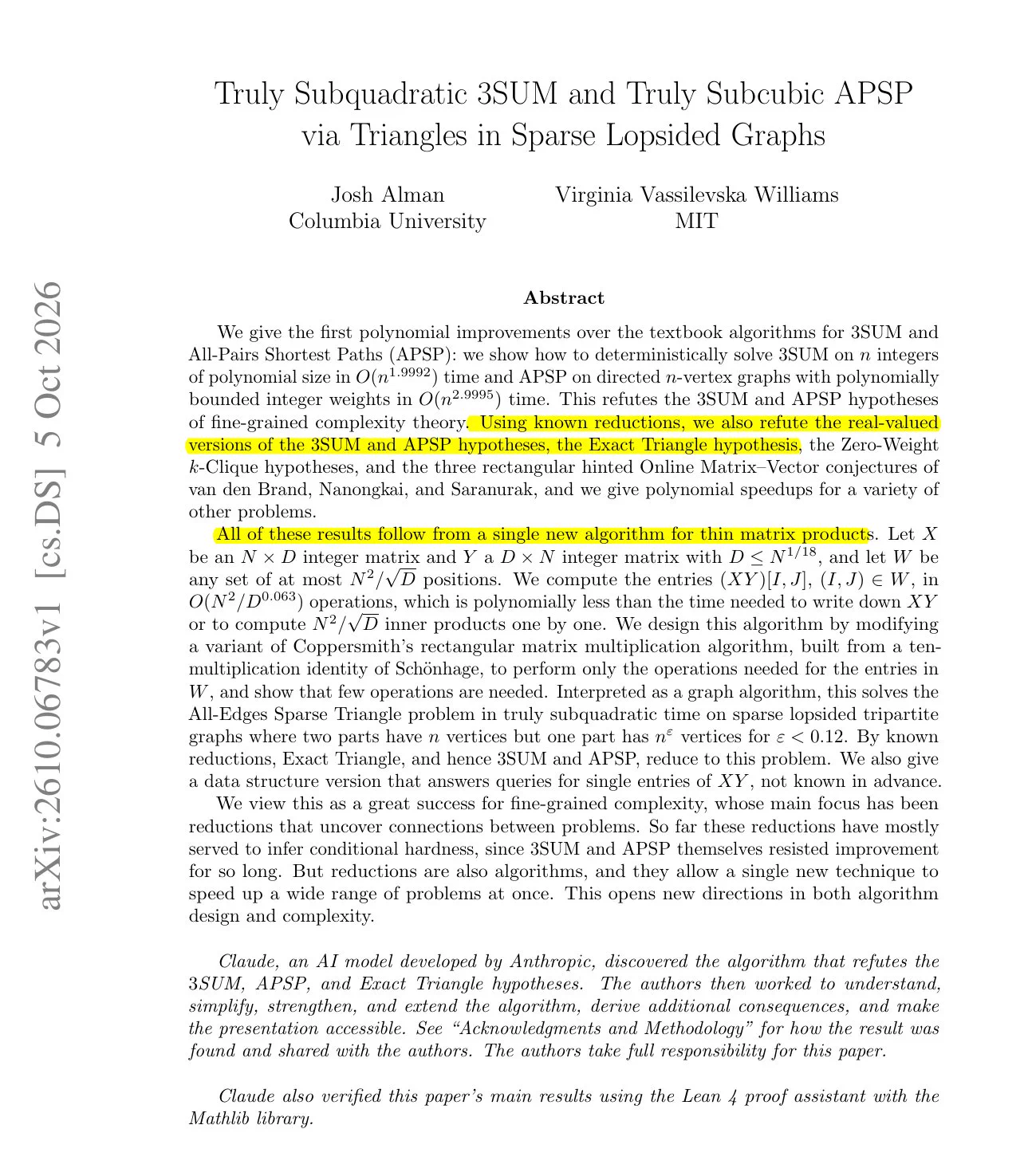
Columbia and MIT Paper: Claude-Discovered Algorithm Breaks Long-Standing Speed Limits for 3SUM and APSP
77 pts · 4 min read

Fields Medalist Maynard on Claude-Assisted Riemann Hypothesis Proof: Believed Correct, but Must Be Understood to Gain Acceptance
85 pts · 5 min read
OpenAI Releases Preprint: GPT-6 Models Demonstrate Intrinsic Protein Design Capability
82 pts · 6 min read