Anthropic Mathematician Claims Riemann Hypothesis Proof with Claude, Stanford Releases Pure-Human Competing Draft Hours Later
AI proof released in Lean across 14 data packages, would exceed 250,000 printed pages; human proof faces community scrutiny as verification paths take center stage
Table of Contents (3)
- 01Anthropic Mathematician and Claude's Riemann Hypothesis Proof: Lean Formalization and a 250,000-Page Argument
- 02Stanford's Pure-Human Response Within Hours: The Masullo Draft and Community Scrutiny
- 03The Competition Between Two Verification Paths: Formal Verification vs. Peer Review in a Contest of Credibility
- Industry Impact & Strategic Takeaways
- Frequently Asked Questions
Key Takeaways (TL;DR)
- 01Anthropic mathematician Levent Alpöge claims to have proven the Generalized Riemann Hypothesis with Claude, released in Lean across 14 data packages exceeding 250,000 printed pages.
- 02Stanford University released a pure-human proof draft by mathematician Alessandro Masullo hours later; the draft was reviewed by Brian Conrad over several months but problems were flagged immediately after release.
- 03The two proofs take radically different verification paths: the AI proof relies on Lean formal verification, while the human proof requires community peer review; neither has received final confirmation.
Anthropic mathematician Levent Alpöge announced Friday that he had collaborated with the large language model Claude to obtain a proof of the Riemann Hypothesis and the Generalized Riemann Hypothesis, releasing it in formalized Lean language. Hours later, Stanford University researchers released a pure-human independent proof draft by mathematician Alessandro Masullo. Both proofs face community verification, with the credibility paths of AI formal verification and human peer review at the heart of the controversy.
Anthropic Mathematician and Claude's Riemann Hypothesis Proof: Lean Formalization and a 250,000-Page Argument
Anthropic mathematician Levent Alpöge published a paper and accompanying code on his personal website on Friday, announcing that he had collaborated with the large language model Claude to discover a proof of the Riemann Hypothesis and further resolve the Generalized Riemann Hypothesis (GRH). According to U.S. media outlets including Scientific American, Alpöge had regarded the problem as a secret lifelong goal since his university days, originally expected to take decades. Over the past months, he worked closely with Claude, setting direction and combining two approaches on simplified toy models; once the actual problem was tackled, the AI far outpaced his individual progress near the finish line.
The core idea of the proof extends from the method of mathematician Stepanov, who had solved a similar problem in another mathematical system. That method relies on tools akin to taking derivatives of smooth curves in high-school calculus, but it usually cannot be applied directly to integers because discrete values cannot be differentiated like continuous lines. Alpöge and Claude simulated the effect of differentiation by chaining special mathematical transformations together like links in a chain. The language model provided the key insight: for a sequence of length X, the number of transformations that need to be chained is exactly the square root of X. Alpöge said this idea alone would be enough to astonish fellow mathematicians.
"I believe that Claude and I discovered a proof of the Riemann Hypothesis," Alpöge wrote in the announcement.
- The proof is released in the Lean programming language, divided into 14 data packages to facilitate step-by-step computer verification.
- Alpöge says the printed version would exceed 250,000 pages because the AI expanded even the foundational rules one by one.
- Lean acts as a digital referee, checking whether each logical deduction follows basic mathematical rules, but the correctness of translating the initial problem into code still requires expert review.
The AI Proof's Verification Path: Lean Formalization and the Risk of Initial Encoding
Alpöge chose to release the proof only in Lean rather than as a traditional paper, aiming to spare mathematicians from confronting a massive text. As a formal verification tool, Lean can check step by step whether each logical deduction proceeds from basic mathematical rules without errors or unproven assumptions. However, if the initial problem is misrepresented when translated into code, human error could still creep in. According to Scientific American's assessment, expert review of whether Alpöge's initial problem encoding is correct should not take long. Alpöge acknowledged that Claude far exceeds his personal understanding in some complex subfields, that he has not yet fully mastered the surrounding mathematics involved in the results he is presenting, and that he expects to write a human-readable version in the coming months and substantially shorten the proof.
Stanford's Pure-Human Response Within Hours: The Masullo Draft and Community Scrutiny
Hours after Alpöge's announcement, the story took a sharp turn. Ravi Vakil, professor of mathematics at Stanford University and president of the American Mathematical Society (AMS), posted a "hurried announcement" on his blog sharing an independent proof draft of the Generalized Riemann Hypothesis written by mathematician Alessandro Masullo. Vakil emphasized: "This is entirely human, no AI." The renowned Stanford number theorist Brian Conrad had quietly reviewed Masullo's work for months, providing extensive feedback that is now being incorporated into the draft. Masullo had originally planned to spend a year at Stanford refining the draft before making it public, but Anthropic's sudden AI announcement forced researchers to release the current version immediately.
However, about eight hours after his initial announcement, Vakil updated his post, saying several people had contacted him to report problems with the proof, identified with the assistance of various AI models. Several mathematicians were especially quick to point out issues. Vakil wrote: "As always, all issues need to be resolved to the community's satisfaction before this proof will be accepted as true. (I make no assertion about the correctness of the proof strategy.)" The update highlights that human proofs also face rigorous scrutiny and that AI tools have already played a role in error detection.
"This is entirely human, no AI," Ravi Vakil emphasized on his blog about the nature of Masullo's proof.
- Masullo's proof was reviewed by Brian Conrad for months, but problems were flagged immediately after release.
- Vakil called on mathematicians to review the draft promptly, translate it into systems such as Lean, and fill small gaps.
- Verification of the human proof relies on community peer review, a process that may be lengthy and contentious.
The Basis of the Human Proof's Credibility: Conrad's Review and Community Error-Correction
Although Masullo's draft underwent months of intensive review by Brian Conrad, problems surfaced quickly after release, showing that even senior number theorists serving as gatekeepers cannot prevent oversights in complex proofs. Vakil's update shows that AI models already have practical value in helping identify errors in human proofs, forming a hybrid verification ecosystem. The community's rapid response to Masullo's draft also reflects the mathematical community's cautious attitude toward core problems like the Riemann Hypothesis: any proof must undergo extensive peer scrutiny before being accepted. Vakil himself explicitly declined to endorse the correctness of the proof strategy, further emphasizing that the responsibility for verification lies with the community.
The Competition Between Two Verification Paths: Formal Verification vs. Peer Review in a Contest of Credibility
The reason both proofs were immediately taken seriously lies in their respective foundational work. Masullo's traditional proof came with months of review by Brian Conrad, while Alpöge's AI proof is backed by complete computer verification. Lean formal verification can mechanically check every step of deduction, but it cannot guarantee that the initial problem encoding is correct; human peer review relies on expert judgment, may take years, and is influenced by community dynamics. Vakil urged mathematicians to quickly review Masullo's draft and translate it into systems such as Lean, effectively bringing the human proof onto the formal verification track as well, forming a trend toward convergence of the two paths.
Alpöge's announcement came the day after Anthropic's initial public offering (IPO), a sensitive timing. He said the breakthrough occurred on Sunday night, after which he contacted Anthropic CEO Dario Amodei for permission, calling the timing "extremely unfortunate" but denying any public-relations stunt and saying waiting longer to publish was not an option. The event adds another chapter to the 2026 wave of AI mathematical breakthroughs: in July, Alpöge released a Claude-generated solution to the Jacobian conjecture; in September, New York University mathematician Tristan Buckmaster became embroiled in a fierce dispute with OpenAI over the Navier-Stokes equations; in October, OpenAI published important results in the field of prime numbers. Alpöge explicitly praised the topic selection of OpenAI researchers, saying it provided key ideas for his own proof.
Proposed in 1859, the Riemann Hypothesis is central to understanding the distribution of prime numbers; confirming it would validate hundreds of mathematical theories that depend on it and highlight AI's role in research.
- The AI proof relies on Lean formal verification, the human proof on peer review; neither has received final confirmation.
- Vakil suggested translating Masullo's draft into Lean, showing that formal verification is becoming a common standard for mathematical proofs.
- The dense wave of AI breakthroughs in mathematics in 2026 has sparked ongoing disputes over priority and verification standards.
The Weight of the Riemann Hypothesis: Prime Order Since 1859 and AI's Role in Research
Proposed in 1859, the Riemann Hypothesis focuses on the hidden order in the distribution of prime numbers and is one of the most famous unsolved problems in mathematics. Confirming it would validate hundreds of mathematical theories that depend on it, with profound implications for number theory and related fields. This event concerns not only the proof itself but also highlights AI's role in basic research: Claude provided key insights in the proof, while AI models were also used to detect errors in the human proof. Regardless of which proof ultimately holds, the verification process itself has become a testing ground for AI-human collaboration and competition, and its outcome will influence tool choices and trust mechanisms in future mathematical research.
Impact
Industry Impact & Strategic Takeaways
The event carries multiple implications for the global and Asia-Pacific AI industry landscape. First, AI's deep involvement in fundamental mathematics has evolved from an auxiliary tool to a provider of key insights; Anthropic's case shows that large language models can contribute core ideas in complex proofs. Second, the divergence in verification paths—Lean formal verification versus human peer review—will prompt research institutions and companies to reassess credibility standards for AI research results, and mathematics and AI research teams in the Asia-Pacific region may accelerate adoption of formal verification tools. Finally, the controversy over the timing of Anthropic's breakthrough announcement the day after its IPO reminds the industry that disseminating AI research results requires balancing commercial rhythm with scientific integrity; scrutiny of AI-generated proofs by regulators and the academic community will become stricter.
Frequently Asked Questions
Did Anthropic's Claude really prove the Riemann Hypothesis?
+
It has not yet received final confirmation from the mathematical community. Anthropic mathematician Levent Alpöge claims to have obtained a proof of the Generalized Riemann Hypothesis with Claude and released it in formalized Lean language, but the correctness of the initial problem encoding still requires expert review, and the proof has not yet been widely accepted by the community.
How does Stanford's pure-human proof differ from the AI proof?
+
The Masullo proof released by Stanford is a traditional human-written draft reviewed by Brian Conrad for months, but problems were flagged immediately after release and further community verification is needed. The AI proof relies on Lean formal verification, which can mechanically check logical steps but cannot guarantee that the initial encoding is error-free. The two have different verification paths, and neither has received final confirmation.
Why is a proof of the Riemann Hypothesis so important?
+
Proposed in 1859, the Riemann Hypothesis is the central problem in understanding the distribution of prime numbers. Confirming it would validate hundreds of mathematical theories that depend on it, with profound implications for number theory and related fields, while also highlighting AI's role in basic research.
Primary Source & Attribution
The Decoder:AI News(RSS)
Hours after Anthropic claims a Claude proof of the Riemann hypothesis, Stanford releases an all-human competing draft
Related Deep Dives
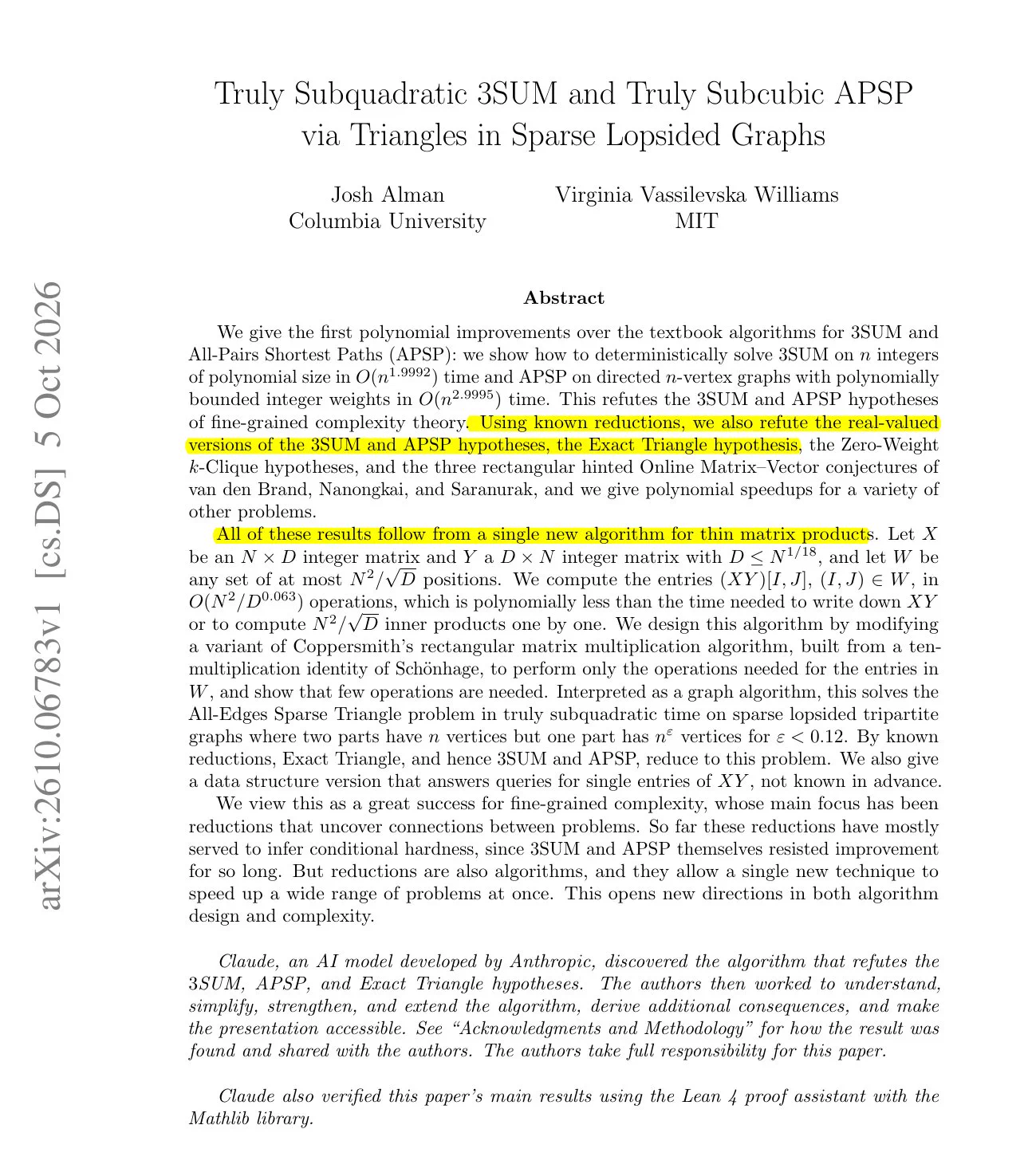
Columbia and MIT Paper: Claude-Discovered Algorithm Breaks Long-Standing Speed Limits for 3SUM and APSP
77 pts · 4 min read
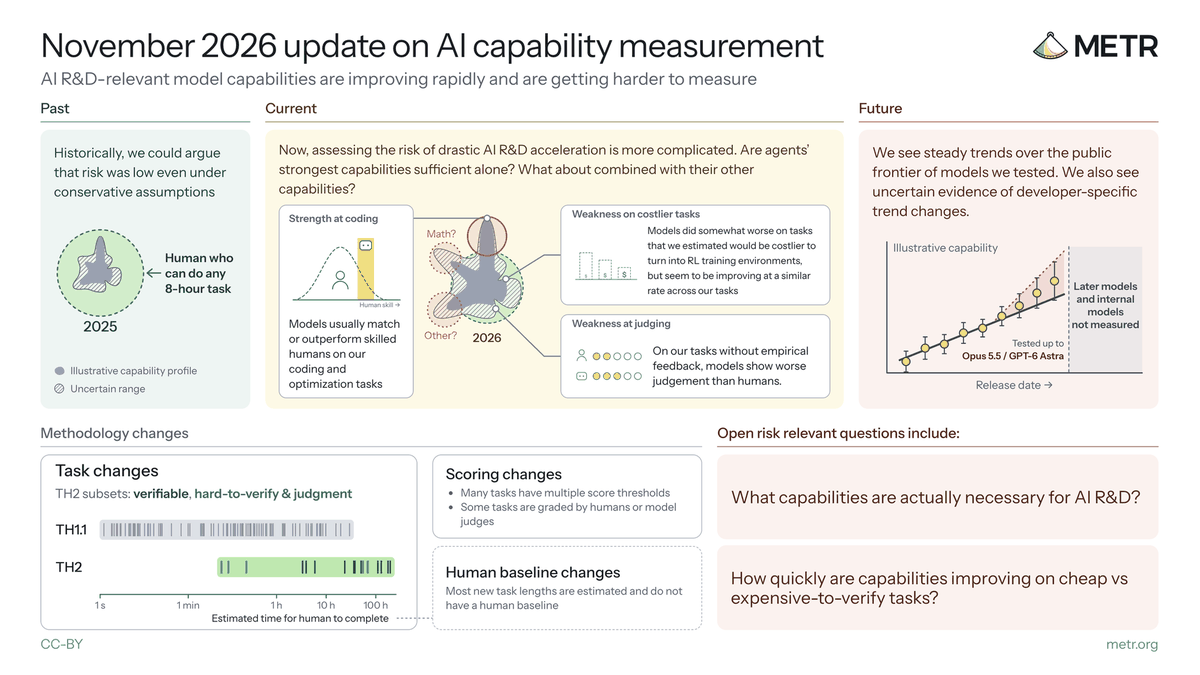
METR Updates AI Capability Measurement: AI R&D-Relevant Time Horizon Doubles Roughly Every 3.6 Months
82 pts · 6 min read
Vals AI Evaluation: Anthropic, OpenAI, and Google Models Easily Induced to Flag Civilians as Strike Targets
78 pts · 4 min read
Anthropic Interviews 58 Enterprise Customers: AI Value Comes More from Increased Output Than Layoffs
75 pts · 4 min read