METR Updates AI Capability Measurement: AI R&D-Relevant Time Horizon Doubles Roughly Every 3.6 Months
Evaluation covers Opus 5.5 and GPT-6 Astra; verifiable subset doubles in about 1.65 months; convergence of evaluation and training environments poses measurement challenges
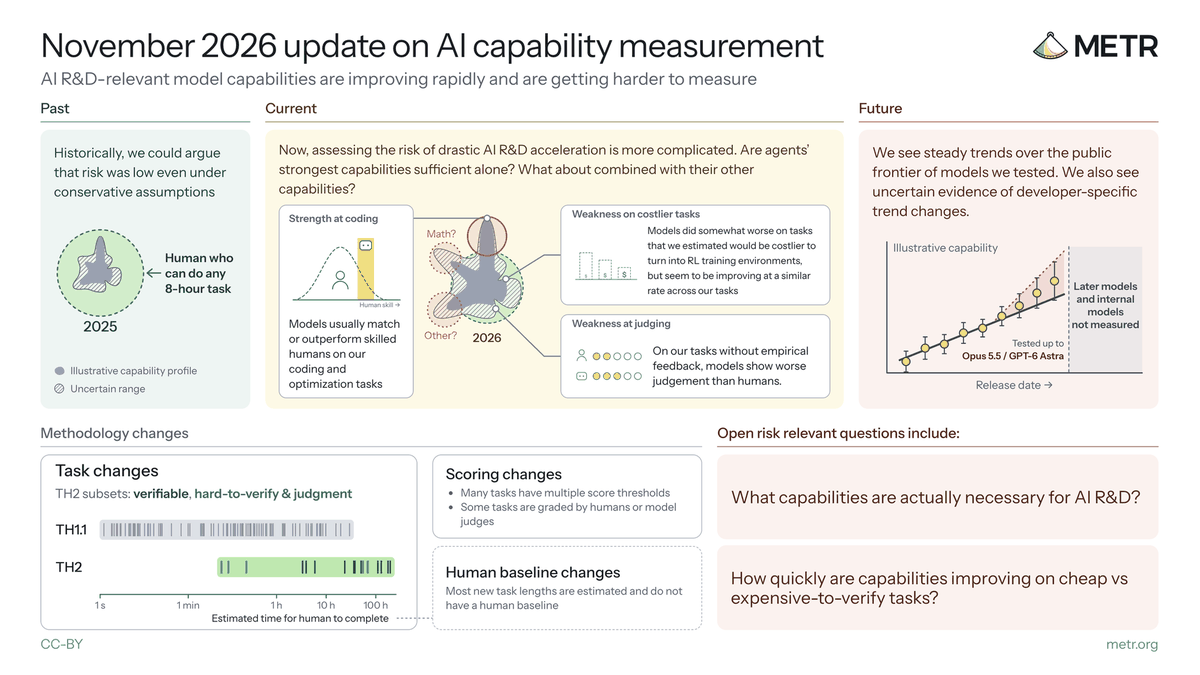
Table of Contents (3)
- 01Combined Task Suite Time Horizon Doubles About Every 3.6 Months; Verifiable Subset Faster
- 02Coding and Optimization Tasks Match Humans; Judgment Tasks Remain a Weak Spot
- 03Composite Index Shows No Overall Acceleration; Developer-Level Trends Uncertain
- Industry Impact & Strategic Takeaways
- Frequently Asked Questions
Key Takeaways (TL;DR)
- 01METR measured model time horizons doubling roughly every 3.6 months on the combined TH1.1 and TH2 suite, similar to recent trends OpenAI reported on internal research tasks.
- 02Looking only at the verifiable subset of TH2, the doubling time shortens to about 1.65 months, potentially suggesting that the combined trend masks recent acceleration.
- 03Models typically match or surpass skilled humans on coding and optimization tasks, but show weaker judgment than human experts on judgment tasks lacking clear experiential feedback.
- 04Evaluations that are more realistic are more expensive; METR quantifies this with lifecycle cost: a doubling of task cost imposes a difficulty penalty roughly equivalent to halving the time horizon.
METR has released a capability evaluation update covering Opus 5.5 and GPT-6 Astra, finding that on the combined TH1.1 and TH2 task suite, model time horizons double roughly every 3.6 months, while the verifiable subset doubles in about 1.65 months. The report also highlights evaluation cost and measurement bias issues.
Combined Task Suite Time Horizon Doubles About Every 3.6 Months; Verifiable Subset Faster
METR has published an update to its public model capability evaluations covering Opus 5.5 and GPT-6 Astra. The core metric remains time horizon—the length of continuous autonomous work required to reach a given score threshold on a task. On the combined TH1.1 and TH2 suite, model time horizons double roughly every 3.6 months. Because TH2 is more difficult, the same model's 50% time horizon on the combined suite is lower than its reading on TH1.1 alone—a difference that must be considered when interpreting the trend.
The report also notes that if one looks only at the verifiable subset of TH2 and excludes TH1.1, the doubling trend is markedly shorter, at about 1.65 months. METR's analysis suggests this may be related to a recent acceleration in time horizon growth, but that this acceleration is masked by the combined trend; however, the report also lists other plausible explanations and does not treat this as a conclusion. The doubling rate of the combined suite is similar to the trend OpenAI recently reported on internal research tasks.
METR states that current public evidence is insufficient to rule out dramatic AI R&D acceleration in the coming years.
- Combined TH1.1 and TH2 suite: time horizon doubles roughly every 3.6 months
- TH2 verifiable subset (excluding TH1.1): doubling time about 1.65 months
- TH2 is more difficult; the same model's 50% time horizon on the combined suite is lower than its reading on TH1.1 alone
Why the Combined Trend May Underestimate Recent Acceleration
METR's explanation is a change in task difficulty structure: TH2 is overall harder, and models score lower at the same time horizon, so combining TH1.1 and TH2 flattens the trend line. If recent capability gains are concentrated in verifiable tasks with clear feedback, then looking only at the verifiable subset would reveal a steeper slope. The report emphasizes that this is only one possibility and that sample and methodological choices can still affect the conclusion.
Coding and Optimization Tasks Match Humans; Judgment Tasks Remain a Weak Spot
On METR's coding and optimization tasks, models typically match or even surpass skilled humans. When METR recruited human baseline testers itself, in most cases it could not find humans who outperformed current frontier models; in the few cases with records of attempts by a dozen or so domain experts, models often landed at very high percentiles but were not absolutely first. This result suggests that on tasks with clear specifications and feedback, frontier models' autonomous execution capability has approached or reached expert level.
The shortfall appears on judgment tasks that require making choices without clear experiential feedback. METR found that AI agents show weaker judgment than human experts on such tasks, which is especially critical when feedback is slow or when existing tests provide only limited evidence of generalization. The report gives an example: compared with expert graders, model reviewers overestimate the quality of outputs when those outputs are generated by models of comparable or greater capability.
METR observed that model reviewers overestimate output quality when the output is generated by a model of comparable or greater capability.
- Coding and optimization tasks: models typically match or surpass skilled human baselines
- In multi-expert cases, models are at very high percentiles but not absolutely top-tier
- Judgment tasks lacking clear feedback: AI agents show weaker judgment than human experts
Evaluation Cost and Measurement Bias
METR uses lifecycle cost—a model-estimated metric—to quantify the tension between realism and expense in evaluations: making an evaluation more realistic often also makes it harder to build, run, and score. In its data, for a task of a given length, a doubling of lifecycle cost imposes a difficulty penalty roughly equivalent to halving the agent's time horizon. Nevertheless, METR observed similar rates of progress on high-cost and low-cost task subsets, and even on the most expensive tasks, AI performance improved over time.
Composite Index Shows No Overall Acceleration; Developer-Level Trends Uncertain
To track changes in the overall capability of public frontier models, METR uses the METR Capability Index (MCI), based on item response theory (IRT), with a statistical modeling approach similar to the Epoch Capabilities Index. On the public models tested, the overall frontier trend shows no clear acceleration or deceleration, but under some conditions developer-specific trend changes were observed. METR is cautious about these findings because the results are sensitive to methodological choices.
For robustness checks, METR examined reward hacking and refusals, among other things, and evaluated the effectiveness of agent swarms as a capability elicitation method. Results show that on verifiable tasks with clear metrics and fast feedback, agent swarms appear to help relative to best-of-k; on other tasks, the effect is unclear or negative. The report also discusses open questions in evaluating AI R&D acceleration.
METR notes that the convergence of evaluation environments and reinforcement learning training environments may introduce measurement bias.
- MCI is based on IRT modeling; the overall frontier trend shows no clear slope change
- Some developer-specific trend changes exist, but they are highly method-sensitive
- Agent swarms show benefits only on verifiable tasks with clear metrics and fast feedback
Implications for Evaluation Design
In the report, METR discloses methodological details, including difficulty estimation and baseline setting, time horizon diagnostics, the MCI modeling approach and its limitations, task lifecycle cost estimation, data integrity and reward hacking checks, and appendix content on inference scaling and swarm experiments. For evaluation designers, these materials provide a reusable framework: how to maintain task realism under cost constraints, how to use multiple score thresholds to reduce noise from a single threshold, and how to identify optimistic bias caused by convergence between training and evaluation environments.
Impact
Industry Impact & Strategic Takeaways
METR's update moves the discussion of AI R&D acceleration from qualitative judgment toward a verifiable quantitative trend: the coexistence of two doubling times—3.6 months and 1.65 months—suggests that the combined metric may mask structural acceleration. For the Asia-Pacific AI industry, this means model selection and risk assessment cannot rely on a single benchmark alone; attention must be paid to task verifiability, feedback speed, and evaluation cost. At the same time, the bias introduced by convergence between evaluation and training environments requires companies to retain independent tasks and human expert baselines in internal evaluations.
Frequently Asked Questions
What is the 'time horizon' METR refers to?
+
Time horizon is the metric METR uses to measure the length of continuous work an AI agent can perform autonomously on a task, typically defined as the duration required for a model to reach a given score threshold on a task. METR measures this metric on task suites such as TH1.1 and TH2 and uses its doubling time to track the rate of capability growth.
Why is the doubling time so different between the combined suite and the verifiable subset?
+
TH2 is overall more difficult, and the same model's 50% time horizon on the combined suite is lower than its reading on TH1.1 alone, so the combined trend is flattened. Looking only at the verifiable subset of TH2, the doubling time is about 1.65 months. METR believes this may reflect recent acceleration being masked by the combined trend, but other explanations exist and the matter is not settled.
Does METR believe AI already has the capability to dramatically accelerate AI R&D?
+
METR explicitly states that significant uncertainty remains on the core question, including what capabilities are actually needed to achieve dramatic acceleration and how quickly the relevant capabilities are improving. The report says current public evidence is insufficient to rule out dramatic AI R&D acceleration in the coming years, but it does not assert that it has already occurred.
Primary Source & Attribution
METR:Research(网页)
Related Deep Dives

Vals AI Evaluation: Anthropic, OpenAI, and Google Models Easily Induced to Flag Civilians as Strike Targets
78 pts · 4 min read
OpenAI Releases GPT-6.2 Astra and Sol: Topping the Value Chart, But Mixed Reviews and the Battle for Anthropic's Strongest Model
83 pts · 7 min read

The Early Backer Behind Anthropic's IPO: Karina Nguyen Recalls the 'Post-Training Hell' Days with Investor Sol
79 pts · 5 min read

Matrix Multiplication Exponent Proven Exactly 9/4, Filling a Longstanding Lower-Bound Gap
71 pts · 5 min read