Curated global AI briefings, structured deep-dive articles, and independent LLM benchmarks
ChatGPT has launched GPT-6.2 Sol, optimized for everyday conversation, in the Chat tab, available starting today to Plus, Pro, Business, and Enterprise users. The version is better at handling complex requests and online information lookup, can recognize details such as label text and street sign symbols in photos, and narrows options based on preferences like price and location.
Cognition has released SWE-2.1 and the high-speed SWE-2.1 Lightning, both trained via pure reinforcement learning on Kimi K3. The models show substantial gains over SWE-2 on benchmarks including FrontierCode 2.0 and Terminal-Bench 4.1, reach 80% on ExploitBench, and deliver significantly enhanced cybersecurity capabilities.
Figma announced that its AI agent, Figma agent, is now available to all paid plan users in FigJam and Figma Slides. Users can import design files, meeting notes, or research notes via connectors and attachments, letting the agent organize whiteboard content or generate presentation drafts, reducing manual work in upfront preparation and follow-up cleanup.
Anthropic announced that Claude's monthly review (Reflect) is now officially available on web, desktop, iOS, and Android, covering Free, Pro, Max, and Ultra plans, and can incorporate Claude Code sessions and cloud-based Cowork tasks. Meanwhile, artifacts can be installed as Mac or Windows desktop apps, and connector file transfer has entered beta.
Google DeepMind has published a new paper in which multiple Gemini 4 agent teams work with Lean formal theorem proving to improve quantum algorithms, generating mathematically verified, efficient quantum circuits. In an inertial confinement fusion scenario, computational cost was reduced 11.8x and the number of required error-corrected qubits fell from 5,650 to 4,338. The team has also open-sourced its Lean library, problem specifications, and verified solutions on GitHub.
OpenRouter has published a tutorial showing how Claude, which lacks native image generation, can call image models through the OpenRouter MCP server. The setup involves adding a remote connector in the Claude app or Claude Code, with no local installation required. In testing, four models cost between $0.035 and $0.094 per image.
The Lean and Mathlib community has issued a statement confirming that Stanford mathematician Levent Alpöge's proof of the Riemann Hypothesis is correct. The proof was released on November 20, 2026, as 17 million lines of Lean code. Dozens of people independently ran it and obtained the same result, and the verification program is designed to be provably incapable of accepting a flawed proof.
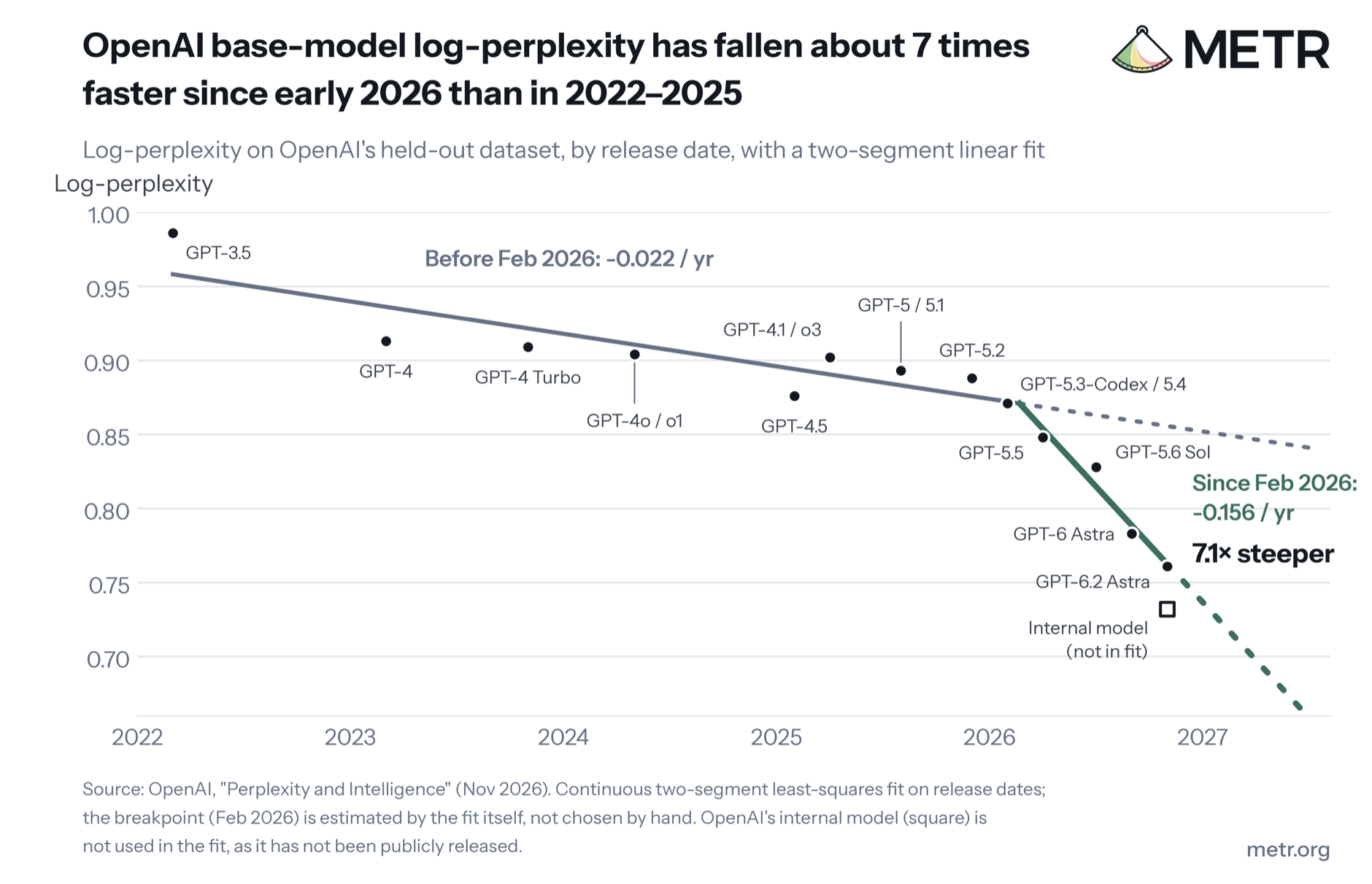
METR analyzed the log-perplexity of 13 OpenAI models on a fixed holdout dataset and found that since early 2026, pretraining loss has been declining about 7 times faster than from 2022 to 2025. At the current rate, the three-year loss reduction from GPT-3.5 to GPT-4.1 could be achieved in about six and a half months, but benchmark scores have not shown a comparable acceleration.
Google announced the expansion of Personal Intelligence in Search's AI Mode, allowing users to securely connect Google Wallet, Drive, and Gemini apps. Wallet is available starting today, with Drive and Gemini apps following in the coming weeks. Users can turn connections on or off at any time.
James Maynard, winner of the 2022 Fields Medal, stated that the Riemann Hypothesis proof completed by Anthropic mathematician Levent Alpöge in collaboration with Claude should be correct, based on the fact that Lean formal verification has passed independent verification. However, he stressed that the proof must be truly understood and clearly explained by the mathematical community before it can gain full acceptance.
Wiz Research has disclosed real-world cloud intrusion cases driven by agentic attack frameworks such as ARTEX, reporting twenty new related incidents in three weeks and a threefold increase in Wiz CIRT case volume. By reconstructing attacker-leaked logs, the research team pieced together both sides of the intrusion and proposed detection approaches for machine-speed attacks.
Anthropic has released the Claude Ship beta, handing PR review, fixes, and merge approvals to AI agents. It consists of the generally available Code Review and the beta agents PR Steward and Claude Approvals, which determine which changes can be merged according to policy files teams write into their repositories.