Fields Medalist Maynard on Claude-Assisted Riemann Hypothesis Proof: Believed Correct, but Must Be Understood to Gain Acceptance
Oxford professor Maynard notes that passing formal verification does not equal recognition by the mathematical community; understanding the ideas behind the proof matters more than the proof itself

Table of Contents (3)
- 01Maynard Judges the Proof Correct: Formal Verification and Track Record Provide Dual Basis
- 02Understanding Takes Precedence Over Proof: The Threshold for Mathematical Recognition Lies Not with Machines but with People
- 03From Claim to Verification: Timeline and Community Reaction
- Industry Impact & Strategic Takeaways
- Frequently Asked Questions
Key Takeaways (TL;DR)
- 01Maynard believes the Riemann Hypothesis proof by Alpöge and Claude is correct, based on the Lean library formal verification having passed independent verification and Alpöge's reliable track record.
- 02Maynard emphasizes that understanding why a theorem holds is far more important than merely proving that it holds; the proof must be understood and clearly explained to others before it can gain full recognition from the mathematical community.
- 03The proof is given in the form of a Lean library, with code of approximately 17 million lines; the Lean and Mathlib communities have issued a joint statement confirming that it has passed verification.
James Maynard, winner of the 2022 Fields Medal, stated that the Riemann Hypothesis proof completed by Anthropic mathematician Levent Alpöge in collaboration with Claude should be correct, based on the fact that Lean formal verification has passed independent verification. However, he stressed that the proof must be truly understood and clearly explained by the mathematical community before it can gain full acceptance.
Maynard Judges the Proof Correct: Formal Verification and Track Record Provide Dual Basis
James Maynard, winner of the 2022 Fields Medal and professor of mathematics at the University of Oxford, said in an interview that he believes the Riemann Hypothesis proof completed by Anthropic mathematician Levent Alpöge in collaboration with the AI model Claude is correct. His judgment rests on two grounds: the proof has passed formal verification in the Lean library, and this verification has itself been independently verified; in addition, Alpöge has a reliable track record in making such major claims.
Maynard is a leading contemporary mathematician in analytic number theory, having long devoted himself to research on mathematical problems such as the distribution of prime numbers, and he won the Fields Medal in 2022 for related research. For this reason, his statement on this AI-assisted proof carries considerable weight in the mathematical community. However, his judgment is not an unconditional endorsement; rather, it places the reliability of formal verification at its core while reminding the public to distinguish between two different levels: "passing verification" and "academic recognition."
Maynard: Understanding why a theorem holds is far more important than merely proving that it holds.
- Maynard's judgment is based on the Lean library formal verification having passed independent verification, as well as Alpöge's reliable record of making major claims in the past.
- The Riemann Hypothesis proof is given in the form of a Lean library, with code of approximately 17 million lines; the Lean and Mathlib communities have issued a joint statement confirming that it has passed verification.
Why Formal Verification Is Regarded as a Key Basis
Formal verification means that every logical step of the proof is translated into machine-checkable code, verified line by line by proof assistants such as Lean. The code for this Riemann Hypothesis proof is approximately 17 million lines; a joint statement issued by the Lean and Mathlib communities confirms that it has passed verification, and dozens of people have reported that the codebase compiles correctly. For Maynard, this layer of machine checking plus independent verification constitutes the technical basis for judging the proof correct.
However, formal verification addresses whether the logical chain is rigorous; it does not automatically equate to the mathematical ideas being understood. Maynard explicitly distinguishes between the two, and this is precisely the core of his statement.
Understanding Takes Precedence Over Proof: The Threshold for Mathematical Recognition Lies Not with Machines but with People
Maynard emphasized that only when someone truly understands this achievement and can explain it clearly to others will the proof be likely to gain full recognition from the mathematical community. He noted that although the Riemann Hypothesis does have some direct mathematical corollaries, the problem is considered so important mainly because people have long expected that explaining this profound internal structure in the distribution of prime numbers would require developing new mathematical theory. In other words, the proof itself is only the starting point; the establishment of a theoretical framework is the transformation the mathematical community truly expects.
In Maynard's view, before we truly understand the ideas and overall framework of the proof, this achievement is likely unable to bring about the transformation people expect. This judgment sets a clear direction for the evaluation criteria of AI-assisted mathematical research: machines can complete logical verification, but the digestion, dissemination, and theorization of mathematical knowledge still need to be done by people.
Before we truly understand the ideas and overall framework of the proof, this achievement is likely unable to bring about the transformation people expect.
- Maynard believes that the proof must be truly understood and clearly explained to others before it can gain full recognition from the mathematical community.
- The importance of the Riemann Hypothesis lies in the fact that explaining the internal structure of prime distribution requires developing new mathematical theory, not merely deriving direct corollaries.
The Debate Over Evaluation Criteria for AI-Assisted Proofs
This incident brings the question of evaluation criteria for AI-assisted mathematical research to the fore. Formal verification provides a machine-checkable guarantee of correctness, but the traditional recognition mechanism of the mathematical community is built on peer understanding, explanation, and theoretical integration. Maynard's statement effectively proposes a dual standard: verification at the technical level and understanding and acceptance at the academic level are two conditions that must be met separately.
He also stated that he believes that over time the mathematical community will eventually truly understand this proof, and that this will certainly fundamentally change the understanding of the relevant mathematical problems. This expectation leaves positive room for the prospect of collaboration between AI and human mathematicians, but it also makes clear that the understanding step cannot be omitted.
From Claim to Verification: Timeline and Community Reaction
On November 20 local time, Anthropic mathematician Alpöge announced that he had, in collaboration with the AI model Claude, solved one of the most famous problems in mathematics—the Riemann Hypothesis. The next day, the Lean and Mathlib communities issued a joint statement confirming that the Riemann Hypothesis proof, given in the form of a Lean library, had passed verification; the code for the proof is approximately 17 million lines, and dozens of people have reported that the codebase compiles correctly.
Maynard's interview statement came after the announcement of this verification result, and its significance lies in providing a cautious judgment from an authoritative mathematician for the discussion surrounding AI's conquest of a top mathematical problem. He neither denied the correctness of the proof nor equated formal verification with academic recognition; instead, he shifted the focus to the more fundamental step of understanding and explanation.
Joint statement from the Lean and Mathlib communities: The Riemann Hypothesis proof has passed verification, with code of approximately 17 million lines.
- On November 20, Alpöge announced the completion of the Riemann Hypothesis proof in collaboration with Claude.
- On November 21, the Lean and Mathlib communities issued a joint statement confirming that the proof had passed verification, with code of approximately 17 million lines.
- Maynard gave a cautious but generally positive judgment in an interview after the verification result was announced.
Impact
Industry Impact & Strategic Takeaways
Maynard's statement sets a reference evaluation framework for AI-assisted mathematical research: formal verification can provide a machine-level guarantee of correctness, but academic recognition still depends on human understanding and theorization of the proof's ideas. For the Asia-Pacific AI industry, this suggests that when promoting AI participation in basic scientific research, explainability and peer review mechanisms need to be built in parallel, rather than using benchmark tests or automated verification alone as the criteria for achievement.
Frequently Asked Questions
Why does Maynard believe the Claude-assisted Riemann Hypothesis proof is correct?
+
He bases this on two points: the proof has passed formal verification in the Lean library and has been independently verified; and Alpöge has a reliable track record in making such major claims.
Does passing formal verification mean the mathematical community has recognized the proof?
+
No. Maynard emphasizes that only when someone truly understands the proof and can explain it clearly to others will the achievement be likely to gain full recognition from the mathematical community.
How large is the code for this Riemann Hypothesis proof?
+
According to the joint statement from the Lean and Mathlib communities, the proof, given in the form of a Lean library, has code of approximately 17 million lines and has passed verification.
Primary Source & Attribution
IT之家·人工智能
菲尔兹奖得主梅纳德谈“AI 攻克黎曼猜想”:相信证明正确,但成果被人理解、才可能得到认可
Related Deep Dives

Anthropic Completes IPO as Dario Amodei Vows to Slow AI Training for Safety
83 pts · 6 min read

Anthropic Mathematician Claims Riemann Hypothesis Proof with Claude, Stanford Releases Pure-Human Competing Draft Hours Later
82 pts · 7 min read
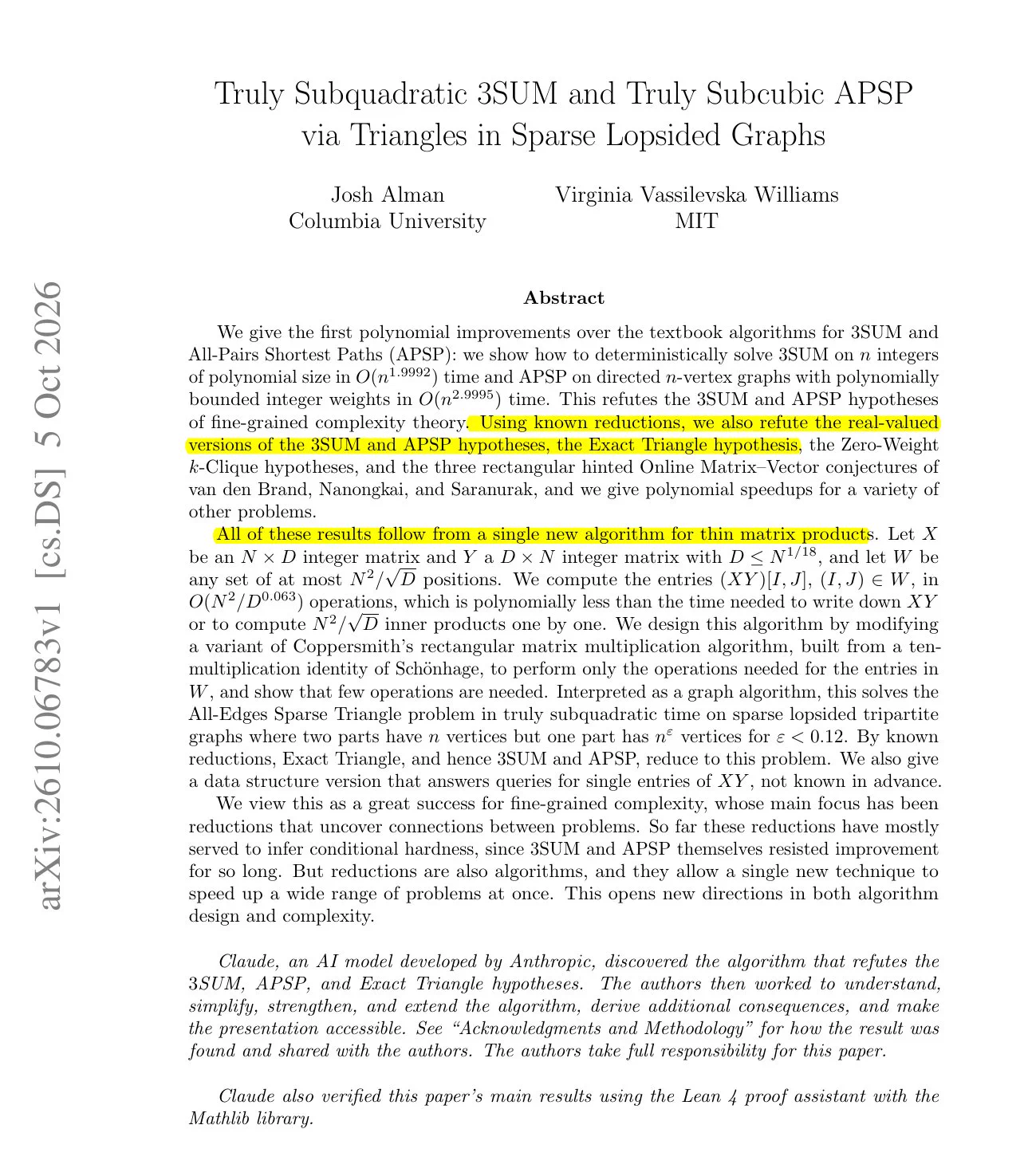
Columbia and MIT Paper: Claude-Discovered Algorithm Breaks Long-Standing Speed Limits for 3SUM and APSP
77 pts · 4 min read

Anthropic Mathematician Alpöge Claims Riemann Hypothesis Proof with Claude, Releases 17.37 Million Lines of Lean Code
70 pts · 6 min read