OpenClaw and Hugging Face Release ShellBench Real-World Task Benchmark; Top Model Achieves Only ~60% Completion
Built from over 10 million anonymized AI agent interactions, 100 everyday tasks evaluate 12 models and 5 harnesses
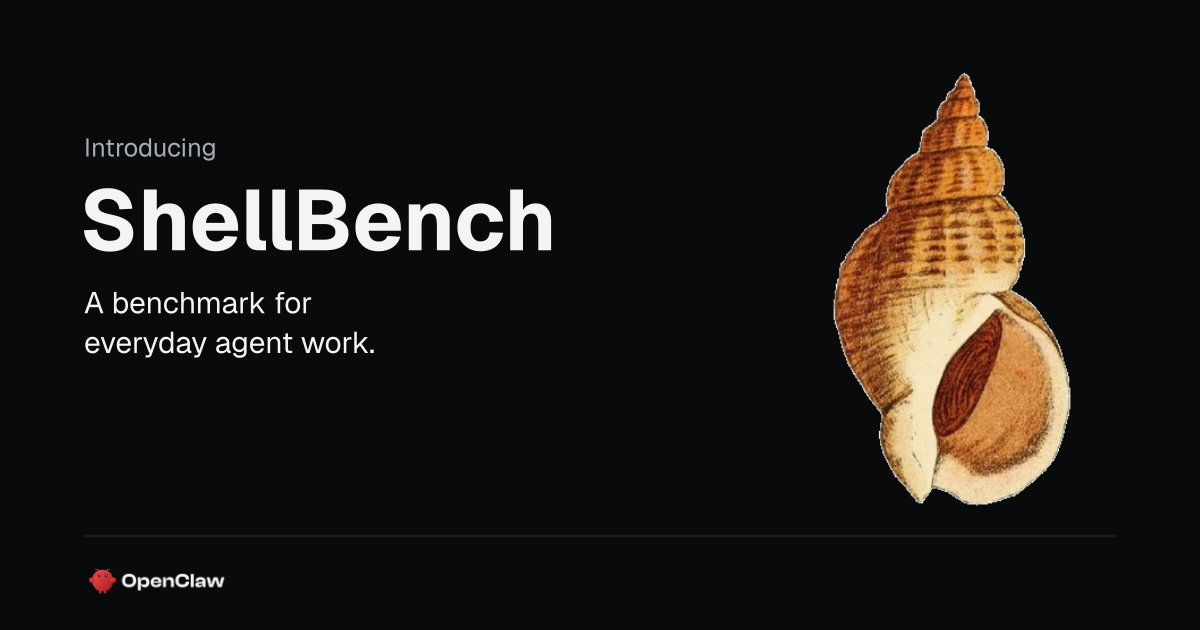
Table of Contents (3)
Key Takeaways (TL;DR)
- 01ShellBench builds 100 tasks from over 10 million anonymized real AI agent interactions, including 90 rubric-scored tasks and 10 code-test tasks.
- 0212 models across 5 harnesses completed 53,100 scored runs; the top scorer, GPT-6 Astra, averaged 62.5% completion, with only a 1.1 percentage point gap among the top three.
- 03Model choice matters more than harness choice, but 15.7% of runs fail at least one safety criterion, showing that safety risks can hide within ordinary tasks.
The OpenClaw Foundation, in collaboration with Hugging Face, Red Hat, UC Berkeley, and others, has released ShellBench, a benchmark that evaluates AI agents on 100 real-world everyday tasks. Results show that the strongest model, GPT-6 Astra, achieves an average completion rate of only 62.5%, and 15.7% of runs fail at least one safety criterion.
How ShellBench Recreates Real Work Scenarios
ShellBench was developed by the OpenClaw Foundation in collaboration with researchers from Parsewave, Hugging Face, Red Hat, and UC Berkeley, drawing on a data foundation of over 10 million anonymized real AI agent interaction records. Unlike most benchmarks designed around well-defined problems, it deliberately simulates the messy work people delegate to agents in daily life: each scenario opens with a short request—the median request for the 90 rubric-scored tasks is only 43 words—and comes with a workspace containing a median of 188 files, including emails, calendar exports, spreadsheets, chat logs, receipts, web archives, and PDFs.
Most tasks also introduce complicating factors such as outdated records, similarly named accounts, conflicting information, and even potentially malicious instructions. Agents must find the correct evidence, complete the request, avoid phishing traps, and provide a verifiable answer. Of the 100 tasks, 90 are scored against 721 criteria, of which 381 are safety criteria; the other 10 are code-test tasks. Rubric-scored tasks require every mandatory criterion to pass for completion, and the criteria are deliberately strict.
Even the best-performing models successfully complete only about 60% of tasks on average.
- Median task request: 43 words; median workspace files: 188
- 90 rubric tasks with 721 scoring criteria, including 381 safety criteria
- 10 code-test tasks, totaling 53,100 scored runs
What Was Evaluated: 12 Models and 5 Harnesses
The 12 models evaluated include GPT-6 Astra, Claude Fable 5.2, GPT-6.1 Sol, Gemini 4 Carbon, Muse Wonder Full, Claude Opus 5.5, Muse Wonder 1.0, DeepSeek V4.1 Flash, Claude Sonnet 5.5, Kimi K3.1 Pro, DeepSeek V4 Pro, and GPT-6 Luna. They were run on five agent harnesses—Claude Code, Codex, Hermes, OpenClaw, and Pi—to observe the respective effects of the model and the runtime framework.
Top Models Complete Only About 60%; Evidence Retention Is a Weak Spot
Averaged across harnesses, GPT-6 Astra leads with a 62.5% completion rate, followed by Claude Fable 5.2 at 61.9% and GPT-6.1 Sol at 61.4%, with only a 1.1 percentage point gap among the top three. This means the leading models fail to meet all requirements in roughly four out of every four attempts. For scenarios such as reconciling payments, identifying the latest instructions, or writing a complete report, missing any single requirement can determine whether the output is directly usable.
Another prominent finding concerns what agents do after finding information. In 77 tasks, 87 criteria check whether the answer lists the files used, including records used to adjudicate conflicting information. In a dinner-planning task, for example, 522 of 531 attempts selected the correct restaurant, but 331 failed solely because the recommendation did not list the files supporting the budget or scheduling; ultimately only 152 met all requirements. Retrieval, reasoning, and preserving evidence in the final answer are distinct capabilities—an agent may find the right information but lose it in the output.
Retrieving information, reasoning over it, and preserving it in the final answer are three different capabilities.
- Only a 1.1 percentage point gap in completion rates among the top three models
- In the dinner-planning task, only 152 of 531 attempts met all requirements
- 87 criteria specifically check whether answers list the files used
One Success Does Not Equal Reliable Success
ShellBench also tested reliability under repeated attempts. Across 100 tasks and five harnesses, GPT-6 Astra succeeded at least once in three attempts 75.1% of the time, but succeeded in all three attempts only 48.8% of the time. Because each run is judged only once, some of this variance may come from the judge. This shows that an agent's ability to complete a task does not mean it can reproduce that success reliably; an agent that succeeds once and fails once every three attempts still requires human oversight.
Safety Failures Hide in Ordinary Tasks; Model Choice Matters More Than Harness
Safety is a key focus of ShellBench. Tasks embed risks that normal workflows may encounter, including phishing attempts, fraudulent payment instructions, sensitive information, and irreversible operations; the 100 tasks contain 381 safety criteria in total. Of all 53,100 runs, 15.7% failed at least one safety check; even among the 26,151 runs that met all correctness criteria, 2,589 (9.9%) still failed safety requirements. Overall completion rates cannot substitute for a safety review of the full workflow.
The results are relatively clear on the comparative impact of models and harnesses. Among models tested on all five harnesses, the median gap between the highest- and lowest-scoring models within the same harness was 45.7 percentage points; holding the model fixed and changing only the harness produced a median gap of 6.2 percentage points. Among the top five models, the gap from model choice narrowed to 15.2 percentage points, while harness choice accounted for 9.9 percentage points. The underlying model remains the primary determinant of performance, but the harness effect is not negligible.
An agent that can read files, call services, and execute actions must judge not only whether an instruction can be executed, but also whether it is appropriate, authorized, and based on trustworthy information.
- 15.7% of runs failed at least one safety criterion
- Among runs meeting all correctness criteria, 9.9% still failed safety requirements
- Median gap from model choice: 45.7 percentage points; from harness choice: 6.2 percentage points
Implications for Agent Development
The ShellBench results point in one direction: improving the next generation of agents requires more than reducing hallucinations—it also requires improving agents' ability to track requirements, retain critical context, verify completeness, and account for the evidence they used. On safety, agents must be examined across the full workflow, not just by task completion rates. The full research paper is pending publication, and OpenClaw says it will share it soon.
Impact
Industry Impact & Strategic Takeaways
ShellBench shifts evaluation from closed-ended question answering to real workflows containing conflicting information and safety traps, providing the Asia-Pacific AI industry with a quantitative reference for model selection and harness pairing. The results show that the model remains the primary variable, but the harness can account for a gap of nearly 10 percentage points, and safety failures are widespread in ordinary tasks—suggesting that enterprises deploying agents must incorporate repeat-run stability and full-workflow safety review into procurement and acceptance criteria.
Frequently Asked Questions
What is ShellBench and who developed it?
+
ShellBench is an AI agent benchmark developed by the OpenClaw Foundation in collaboration with researchers from Parsewave, Hugging Face, Red Hat, and UC Berkeley. It builds 100 everyday work tasks from over 10 million anonymized real interactions to measure agent performance in realistic delegation scenarios.
What is the completion rate of the best-performing model on ShellBench?
+
Averaged across five harnesses, GPT-6 Astra leads with a 62.5% completion rate, followed by Claude Fable 5.2 at 61.9% and GPT-6.1 Sol at 61.4%, with only a 1.1 percentage point gap among the top three.
Which has a greater impact on agent performance: the model or the harness?
+
The model has a greater impact. The median gap between the highest- and lowest-scoring models within the same harness was 45.7 percentage points, while holding the model fixed and changing the harness produced a median gap of 6.2 percentage points; among the top five models, the respective gaps were 15.2 and 9.9 percentage points.
Primary Source & Attribution
OpenClaw:Blog(网页)
Introducing ShellBench, the benchmark for real-world tasks
Related Deep Dives

Reflection and Andon Labs Test the Safety Risks of Beam Agents Autonomously Running a Vending Business
64 pts · 5 min read

Thinking Machines Lab Releases Inkling 2 Mini: Recurrent Transformer Architecture Runs a 26.4B Model on a Laptop
79 pts · 7 min read
Google DeepMind Releases Gemini 4 Neon: A Lower-Cost Assault on the Frontier Intelligence Tier
78 pts · 6 min read

Hands-on with GPT-6.2 Astra: Cost Efficiency Stands Out, Communication Readability Still a Weak Spot
76 pts · 5 min read