Google DeepMind Releases Gemini 4 Neon: A Lower-Cost Assault on the Frontier Intelligence Tier
Scores 61 on the Artificial Analysis Intelligence Index for third worldwide, ranks second on Agent Arena, priced at $3 per million input tokens and $15 per million output tokens, with a 1M-token context window
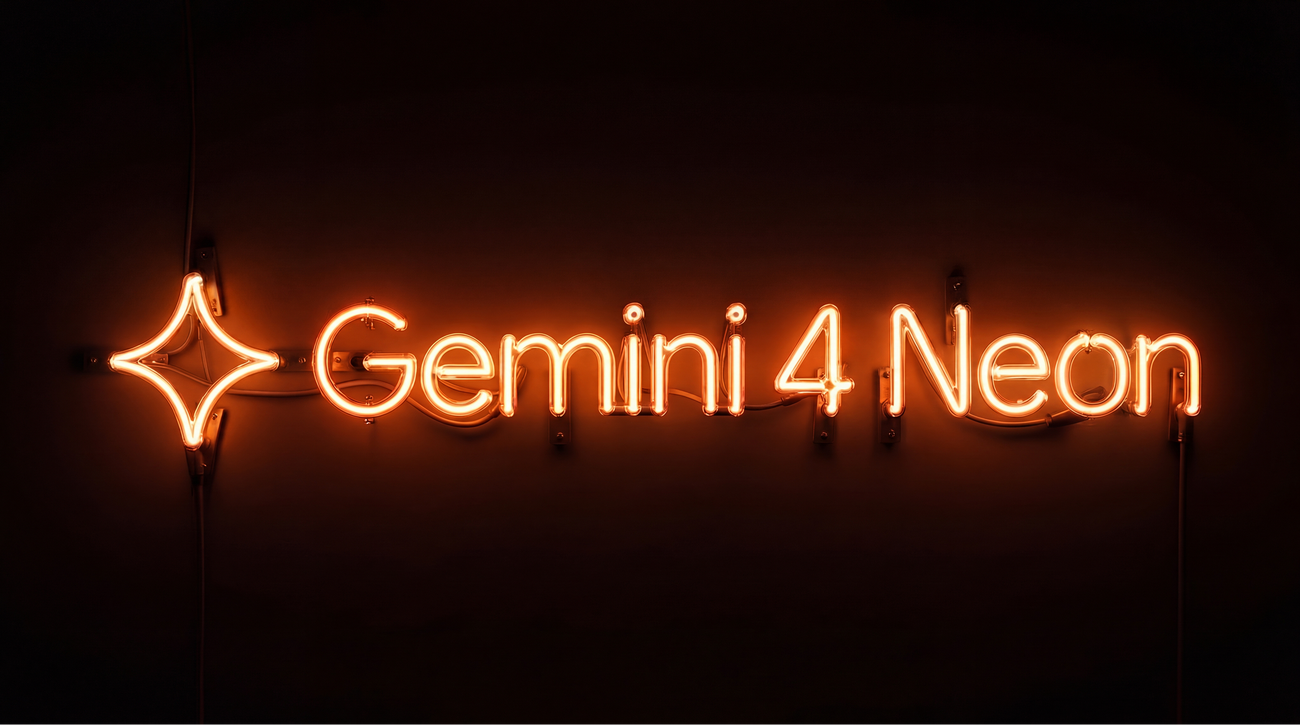
Table of Contents (3)
Key Takeaways (TL;DR)
- 01Gemini 4 Neon scores 61 on the Artificial Analysis Intelligence Index for third worldwide, ranks second on the Vals Index, and places second on the Agent Arena Index with 1,336 points.
- 02Priced at $3 per million input tokens and $15 per million output tokens, with cached input tokens at just $0.15, and a 1M-token context window.
- 03Ranks first on the Artificial Analysis Coding Agent Index (58.6 points), scores 65.2% on Terminal-Bench 4.1, and tops both Zapier AutomationBench and Andon Labs Vending-Bench 2.
Google DeepMind officially released Gemini 4 Neon on November 18, 2026, positioning it around frontier-grade intelligence and fast end-to-end task completion across software engineering, knowledge work, and scientific workflows. The model ranks third worldwide with a score of 61 on the Artificial Analysis Intelligence Index, second on the Vals Index, and second on the Agent Arena Index with 1,336 points, while posting leading results on multiple third-party benchmarks. Pricing is $3 per million input tokens and $15 per million output tokens, with a 95% discount on cached input, and it is available starting today through the Gemini API, Google AI Studio, and other channels.
The Value Path to Frontier Intelligence: The Positioning Logic Behind 61 Points
Google DeepMind defines Gemini 4 Neon as the combination of "frontier-grade intelligence and fast end-to-end task completion." At the xhigh thinking level on the Artificial Analysis Intelligence Index, Neon scores 61, ranking third worldwide, and the company explicitly states that its result is "second only to larger, slower models." This positioning makes clear that Neon is not a flagship chasing the absolute ceiling of capability, but a product seeking a balance between capability, speed, and cost. On the Vals Index, Neon ranks second with 70.9% and sits on the Pareto frontier, meaning that at equivalent cost, few models can clearly surpass it in intelligence.
Beyond raw capability, DeepMind emphasizes the model's "collaborability." On the newly launched Agent Arena Index, Neon scores 1,336 across more than 4,200 real agent sessions, ranking second worldwide, with "steerability"—the ability to adapt mid-task to user corrections—also ranking second. The company also discloses that Neon recorded the lowest hallucination rate to date in internal Google Antigravity tests and excels at multi-step instruction following. These metrics point to a trend: the competitive focus in enterprise AI is shifting from single-point benchmark scores to the reliability and controllability of models in real workflows.
Neon ranks third on the Artificial Analysis Intelligence Index with a score of 61, which the company describes as "second only to larger, slower models"—a product explicitly trading on cost-performance to win the market.
- Scores 61 on the Artificial Analysis Intelligence Index (xhigh thinking level), third worldwide.
- Ranks second on the Vals Index at 70.9%, on the Pareto frontier.
- Ranks second worldwide on the Agent Arena Index with 1,336 points, and second in steerability.
Four Thinking Levels: Letting Teams Tune Intelligence Against Token Spend
DeepMind extends and refines its thinking-level design on Neon, offering four adjustable levels that let teams trade off intelligence against token consumption based on workload. The default high level achieves a high score on the Artificial Analysis Intelligence Index while costing 32% less per task than Carbon; the xhigh level targets the hardest engineering, analysis, and scientific tasks with deeper multi-step reasoning, and the company says its per-task cost remains more than 36% lower than competitors' highest settings. On the Vals Index and Agent Arena, Neon at the high level sits on the Pareto frontier, with per-task costs roughly 50% to 80% lower than top competitors.
From Code to Science: Broad Success Across Third-Party Benchmarks
In developer and researcher workflows, Neon's scorecard is dense. It ranks first on the Artificial Analysis Coding Agent Index with 58.6 points, scores 65.2% on Terminal-Bench 4.1, and scores 46.2% on FrontierCode 2.0 under the default high setting. On SWE-sweep, Neon already achieves a leading 12.8% under the mini-SWE test harness, but jumps to a state-of-the-art 39.0% under the Google Antigravity harness—a comparison that vividly illustrates how much the execution framework amplifies the same model's performance. The company says Neon can perform multi-file debugging and refactoring across repositories and make precise "surgical" edits.
In knowledge and scientific workflows, Neon ranks second on the Vals Index and first on both the Legal Research Bench and the Tax Agent Bench. In Surge AI evaluations, it ranks first on most benchmarks across categories including finance, accounting, spreadsheet modeling, and complex constraint following; it scores 73.5% on Chartography and 75.8% on Agents' Last Exam v1.1. It also ranks first on Zapier's AutomationBench with 56.3% and first on Andon Labs' Vending-Bench 2 long-horizon business simulation with $16,843. On scientific reasoning, it scores 70.5% on Terminal-Bench Science, 84.0% on RiemannBench, and 71.3% on HLE-Diamond.
The same model scores 12.8% on SWE-sweep under the mini-SWE harness but 39.0% under the Google Antigravity harness—the choice of execution framework may determine the ceiling of agentic tasks more than the model itself.
- Ranks first on the Artificial Analysis Coding Agent Index (58.6 points).
- SWE-sweep reaches a state-of-the-art 39.0% under the Antigravity harness, more than triple the 12.8% under the mini-SWE harness.
- Ranks first on both the Legal Research Bench and the Tax Agent Bench, and also tops Zapier AutomationBench and Vending-Bench 2.
The Orchestrator Role: How Neon and Hydrogen Sub-Agents Divide the Work
DeepMind designed Neon for a dual role: it can execute tasks independently, or act as a fast, high-judgment orchestrator directing parallel Hydrogen sub-agents within Google Antigravity. The company says Neon reduces redundant file reads, syncs progress during work, and reliably handles context compaction in long sessions. This design targets the pain points of long-horizon agentic workflows—context bloat and redundant tool calls—which are also the most common cost and stability bottlenecks when enterprises deploy agents today.
Secure Code and Cyber Defense: The Underrated Differentiator
As agentic coding scales, DeepMind makes "generating secure code from the start" a key selling point of Neon. Across the easy, medium, and hard tiers of AutoBaxBench, Neon generates safer code than Carbon, and reaches state-of-the-art performance on the hard tier with 76%. In proactive vulnerability discovery, Neon achieves a state-of-the-art 51.26% on WebExploitBench v1.2 at half the cost of competitors' large models. The company says it delivers frontier-grade performance across the full code-hardening lifecycle—vulnerability discovery, validation, and patching—faster and at lower cost.
Specifically in vulnerability discovery, Neon achieves a state-of-the-art 90.5% on SEC-bench Pro. This set of data reveals an industry signal worth watching: cybersecurity is becoming a new battleground for frontier model competition. For enterprises, this means model selection is no longer just about "which model is smarter," but "which model can simultaneously handle development, auditing, and defense tasks at acceptable cost." Neon's pricing strategy clearly serves this narrative—using lower per-task costs to win scaled deployment in security and compliance workflows.
Neon reaches a state-of-the-art 51.26% on WebExploitBench v1.2 at only half the cost of competitors' large models—security capability is becoming a second competitive dimension beyond model pricing.
- Scores 76% on the hard tier of AutoBaxBench, reaching state-of-the-art.
- Scores 51.26% on WebExploitBench v1.2 at half the cost of competitors' large models.
- Scores 90.5% on SEC-bench Pro for vulnerability discovery.
Availability and Access Channels
Gemini 4 Neon is available starting today through the Gemini API in Google AI Studio, and for enterprise users through the API and model dropdown in Gemini for business. Paying Google AI Pro and Ultra subscribers can use it in Google Antigravity, and Pro and Ultra subscribers can also use it in the Gemini app. The 1M-token context window and 95% discount on cached input give it a clear cost advantage in large-scale document processing and long-session agent scenarios.
Impact
Industry Impact & Strategic Takeaways
The release of Gemini 4 Neon shows that frontier model competition is shifting from "who has the highest score" to "who can reliably complete end-to-end tasks at acceptable cost." An intelligence index score of 61 and a third-place ranking, combined with per-task costs 32% to 80% lower than competitors, provide enterprises with a new cost-performance anchor for technology selection. For developers, the comparison of Neon's SWE-sweep score jumping from 12.8% under the mini-SWE harness to 39.0% under the Antigravity harness is a reminder to prioritize co-optimization of execution frameworks and models; for security teams, the model's built-in vulnerability discovery and code-hardening capabilities could reshape the toolchain structure of traditional penetration testing and code auditing.
Frequently Asked Questions
What are Gemini 4 Neon's pricing and context window?
+
$3 per million input tokens, $0.15 per million cached input tokens (a 95% discount), and $15 per million output tokens, with a 1M-token context window.
On which third-party benchmarks does Gemini 4 Neon rank first?
+
It ranks first on the Artificial Analysis Coding Agent Index (58.6 points), the Legal Research Bench, the Tax Agent Bench, Zapier AutomationBench (56.3%), and Andon Labs Vending-Bench 2 ($16,843), and reaches state-of-the-art performance on the hard tier of AutoBaxBench, WebExploitBench v1.2, and SEC-bench Pro.
How can ordinary users access Gemini 4 Neon?
+
Developers can access it through the Gemini API and Google AI Studio; enterprise users can use it through the API and model dropdown in Gemini for business; paying Google AI Pro and Ultra subscribers can use it in Google Antigravity and the Gemini app.
Primary Source & Attribution
Google DeepMind:Blog(RSS)
Introducing Gemini 4 Neon
Related Deep Dives

Thinking Machines Lab Releases Inkling 2 Mini: Recurrent Transformer Architecture Runs a 26.4B Model on a Laptop
79 pts · 7 min read

DeepSeek Harness at 100 Days: How 13 Plugin Use Cases Are Reshaping AI Workflows
71 pts · 5 min read
OpenAI Unveils Performance Factory: How Codex Agents Automatically Triage 17 Performance Regressions a Day
65 pts · 6 min read
Google Opens Gemini Tasks Free to Six Countries Including US, Japan, and Korea, Enabling Calls and Payments
80 pts · 6 min read