OpenAI Unveils Performance Factory: How Codex Agents Automatically Triage 17 Performance Regressions a Day
Tracking over 1,700 investigations and pinpointing more than 600 root causes in three months, OpenAI offers its first full retrospective on deploying its cloud-based agent factory
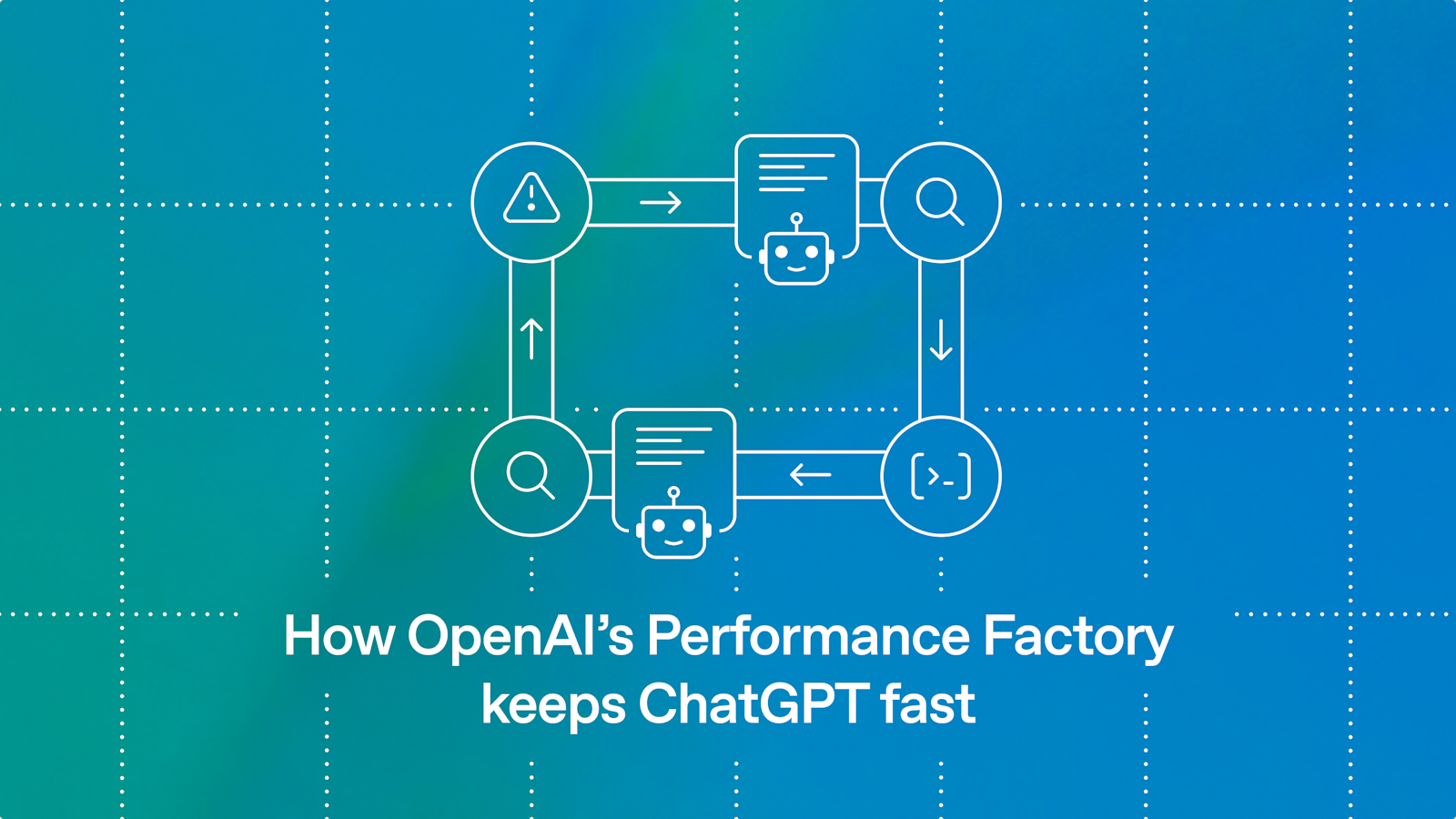
Table of Contents (3)
Key Takeaways (TL;DR)
- 01OpenAI's Performance Factory uses Codex agents to automate performance regression handling end-to-end: from alert triggering and root-cause investigation to fix proposal and post-deployment recovery verification, all driven by workflows.
- 02The Regression Workflow tracked over 1,700 investigations and pinpointed more than 600 root causes in just over three months—about 17 automated investigations per day, significantly surpassing manual triage throughput.
- 03The system comprises four parts: a task service, a scheduling loop, a cloud-based Codex execution API, and a subscription mechanism. Engineers define workflow states and agent behavior through Markdown configuration files and prompts.
OpenAI details its Performance Factory system, which uses Codex agents in the cloud to automatically investigate and fix performance regressions in ChatGPT. Over three-plus months, the Regression Workflow tracked more than 1,700 investigations and identified over 600 root causes—roughly 17 automated investigations per day. The system advances performance engineering from manual triage to end-to-end agentic workflows, providing a reusable, production-grade blueprint for the industry.
From Manual Triage to Agent Factory: The Six-Stage Evolution of Performance Engineering
In an official blog post, OpenAI fully disclosed the build journey of its Performance Factory for the first time. Before Codex, engineers had to manually inspect metrics and logs, compare trace data, debug production machines, and read code to locate performance degradations—a time-consuming task heavily dependent on deep service knowledge. As recurring issues piled up—such as ChatGPT's time-to-first-token regressions—the team accumulated over 30 performance tools, including CPU and memory allocation profilers. But the more tools there were, the harder it became to know which one to use when.
Codex's introduction changed the game. Engineers could directly ask Codex 'why is it slow?' and the agent would search large codebases, locate relevant metrics and traces, trace cross-service interactions, and run appropriate performance analyses. But at this stage, engineers still had to guide the process throughout. The real turning point was codifying the performance team's investigation process into a shared skill called perf-forensics, which tells Codex what tools are available, when to use them, and how to pursue an investigation from multiple angles—tested and iterated with an evaluation set built from historical regression cases.
In just over three months, the Regression Workflow tracked more than 1,700 investigations and pinpointed over 600 root causes—equivalent to 17 automated investigations per day.
- Pre-Codex stage: engineers triaged manually; the team built over 30 performance tools cumulatively
- Codex as a partner: could search codebases and locate metrics and traces, but still required engineer guidance
- perf-forensics skill: encoded the investigation process into a reusable skill, enabling diagnosis in a single run
- Human-proxy stage: engineers reduced to 'copy-paste' middlemen between alerts and Codex
perf-forensics: Encoding Expert Knowledge into an Agent Skill
The core value of the perf-forensics skill lies in making explicit the investigation methodology the performance team has accumulated over years. It guides Codex along three dimensions: determining when the performance degradation began, identifying the scope of affected requests, and judging whether a deployment or configuration change explains the anomaly. OpenAI tested and refined the skill using an evaluation set built from historical regression cases, enabling Codex to deliver diagnoses directly in a single run for specific regression types such as ChatGPT latency and availability drops—without step-by-step human guidance. This practice shows that the ceiling of agentic workflows depends heavily on how well domain knowledge is structured.
The Four Components of Performance Factory and Its End-to-End Workflow
Performance Factory consists of four parts: a task tracker with configurable workflows, a scheduling loop that assigns ready work to agents, an API that runs Codex in the cloud, and a subscription mechanism that wakes agents when changes occur. Engineers define workflows by adding Markdown configuration files and prompts. The configuration files list the states a task can go through, the allowed state transitions, and which steps require human intervention, while separate prompts tell the agent what to do at each step.
Take the Regression Workflow as an example: when a performance alert fires, the system opens a task, and an agent investigates the degradation, records findings in the task, and proposes a fix for engineer review. After deployment, another agent picks up the same task and checks whether performance has returned to baseline. From investigation and writing fixes to verifying mitigation, the entire regression remediation process is automated end-to-end. Each task retains its own state and findings, allowing work to pass between agents and engineers and continue after code review or deployment.
Each task retains its state and findings, allowing work to pass between agents and engineers and continue after code review or deployment—this is what distinguishes a 'factory' from one-off automation.
- Task service: engineers define state machines and prompts in Markdown configuration files; all workflows are visible in a unified UI
- Scheduling loop: periodically checks ready tasks, assigns agents by launching Codex turns, and advances states
- Cloud execution API: runs Codex in the cloud to power automated investigation and remediation
- Subscription mechanism: wakes agents when events such as GitHub review comments or deployment completions occur
Inter-Workflow Linkage: From Discovering Optimizations to Implementing and Verifying Them
Performance Factory is designed for more than single regression fixes. OpenAI says common optimizations can be turned into workflows that run periodically across multiple services; a workflow that discovers potential optimizations can open tasks in another workflow to test and implement them. This task-passing mechanism between workflows gives the system the ability to continuously discover and improve, rather than merely react to alerts. The global visibility of tasks in the UI also lets engineers follow progress and share tasks with teammates who have more context or can drive the next step.
Early Lessons from Running Agentic Workflows in Production
OpenAI summarizes its own path with Codex as an evolution from 'manual labor' to 'collaborating with machines' to 'agent factory.' In the automated investigation stage, the team moved investigations to the cloud, letting alerts automatically start Codex sessions and post findings to Slack threads—but automation stopped at the reply. Engineers still had to take over diagnosis, develop fixes, and verify results. As alerts accumulated, even determining which regressions to prioritize meant digging through numerous Slack threads, which prompted the team to build a full factory system that tracks what each active task needs next and assigns agents when steps are ready.
This retrospective offers direct reference value for teams planning to adopt agentic workflows in production. OpenAI emphasizes that agentic workflows don't happen overnight but evolve along a clear ladder: first make Codex an investigation partner, then codify expert processes into evaluable skills, then move investigations to the cloud to enable alert triggering, and finally build a factory with state management and task-passing capabilities. Each step builds on the proven effectiveness of the previous one, and the evaluation set plays a key role in ensuring skill quality.
OpenAI frames the evolution of software work in three stages: manual labor, collaborating with machines, and agent factory—each building on the proven effectiveness of the previous one.
- If automated investigation stops at Slack replies, engineers still have to manually take over subsequent fixes and verification
- As alerts accumulate, identifying which regressions to prioritize becomes a new bottleneck
- The factory system solves cross-step handoffs through task state tracking and agent scheduling
- An evaluation set built from historical regression cases is the core means of refining agent skill quality
Implications for Service Teams: Start by Codifying Skills
OpenAI explicitly hopes other service teams can learn from its process and adopt agentic workflows in their domains. The reusable part of its path is: first identify investigation-type work that is highly repetitive and expert-dependent, encode its process into agent-executable skills, and validate effectiveness with an evaluation set built from historical cases; then connect the skills to cloud-based triggers; and finally build a task orchestration system with state management. This ladder methodology applies equally to domains beyond performance engineering—such as security response, incident troubleshooting, or data quality monitoring.
Impact
Industry Impact & Strategic Takeaways
OpenAI's practice shows that agentic workflows have moved from experimental assistants to production-grade infrastructure. For the AI industry, this signals that leading vendors are turning model capabilities into orchestration-ready, evaluable, and handoff-capable engineering systems, with the competitive focus shifting from single-point model capabilities to workflow orchestration and domain knowledge codification. For enterprise technology selection and developers, the takeaway is: prioritize encoding highly repetitive, expert-dependent processes into agent skills and build evaluation sets from historical cases; at the same time, confront the trap of automation stopping at 'replies' and invest in task state management and cross-step handoffs to truly unlock the throughput value of the agent factory.
Frequently Asked Questions
What is OpenAI's Performance Factory?
+
Performance Factory is a cloud-based autonomous system built by OpenAI that uses Codex agents to automatically investigate and fix performance regressions in ChatGPT. Engineers define workflow states and prompts through Markdown configuration files, and the system schedules agents to complete tasks and verify performance recovery after deployment.
What quantitative results has the Regression Workflow achieved?
+
In just over three months, the Regression Workflow tracked more than 1,700 investigations and pinpointed over 600 root causes—about 17 automated investigations per day—achieving end-to-end automation from alert triggering to fix verification.
What components make up Performance Factory?
+
The system consists of four parts: a task tracker with configurable workflows, a scheduling loop that assigns ready work to agents, an API that runs Codex in the cloud, and a subscription mechanism that wakes agents when changes occur.
Primary Source & Attribution
OpenAI:官网动态(RSS · 排除企业/客户案例)
Related Deep Dives

DeepSeek Harness at 100 Days: How 13 Plugin Use Cases Are Reshaping AI Workflows
71 pts · 5 min read
Figma Specs and the Figma Agent Workflow: Turning Scattered Context into a Deliverable Development Plan
61 pts · 6 min read
Google DeepMind Releases Gemini 4 Neon: A Lower-Cost Assault on the Frontier Intelligence Tier
78 pts · 6 min read

Kazik Breaks Down the Claude, GPT, and Gemini Multi-Model Orchestration: Divide Work by Personality, Not a Single Version of the Answer
72 pts · 6 min read