Curated global AI briefings, structured deep-dive articles, and independent LLM benchmarks
The Lean and Mathlib community has issued a statement confirming that Stanford mathematician Levent Alpöge's proof of the Riemann Hypothesis is correct. The proof was released on November 20, 2026, as 17 million lines of Lean code. Dozens of people independently ran it and obtained the same result, and the verification program is designed to be provably incapable of accepting a flawed proof.
James Maynard, winner of the 2022 Fields Medal, stated that the Riemann Hypothesis proof completed by Anthropic mathematician Levent Alpöge in collaboration with Claude should be correct, based on the fact that Lean formal verification has passed independent verification. However, he stressed that the proof must be truly understood and clearly explained by the mathematical community before it can gain full acceptance.
Anthropic mathematician Levent Alpöge announced Friday that he had collaborated with the large language model Claude to obtain a proof of the Riemann Hypothesis and the Generalized Riemann Hypothesis, releasing it in formalized Lean language. Hours later, Stanford University researchers released a pure-human independent proof draft by mathematician Alessandro Masullo. Both proofs face community verification, with the credibility paths of AI formal verification and human peer review at the heart of the controversy.
HD Moore, Chief Research Officer at security firm Dragos, planted nearly 2 million canary prompts containing traceable secrets into the AI service chain. He found that at least three AI providers were compromised and prompts were stolen, multiple resellers logged and exfiltrated data, and some providers failed to honor zero-data-retention settings.
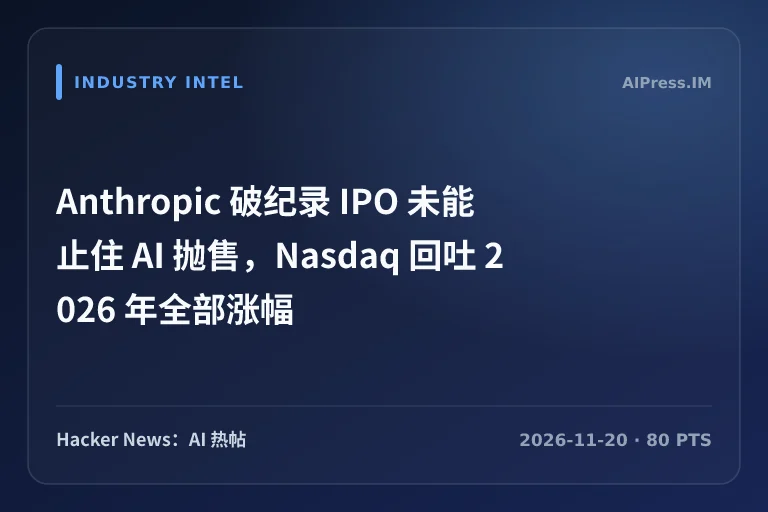
Anthropic's shares fell more than 9% to $88.30 on their second day of trading, closing in on the $83 IPO price, as the record-breaking listing failed to stem the selloff in AI-related companies. The Nasdaq fell 2% on Friday, shedding roughly $4 trillion in market value this week and erasing all of its 2026 gains; Asian stocks posted their worst week since 2020.
Anthropic completed its initial public offering on Nasdaq on November 19, 2026, with shares reaching $111.50 within minutes of the open, 33% above the $83 IPO price. The offer price itself exceeded the company's earlier expected range of $70 to $78. The offering raised more than $81 billion, and combined with concurrent private financing, the company's cash reserves are expected to reach $220 billion; at the opening price, its market capitalization exceeds $2 trillion. CEO Dario Amodei emphasized the company's commitment to safety in his opening remarks.
On November 20, 2026, Thinking Machines Lab released Inkling 2 Mini, an open-weight model built on a recurrent Transformer architecture that runs its middle 12 layers three times per token. With 26.4B total parameters and 3.4B active parameters, it achieves a memory footprint of roughly 20GB and can run locally and offline on Macs with 32GB of memory or more. The model stands out on agentic coding and tool-use benchmarks, and a variable-recurrence research variant was released alongside it for controlled experiments on monitorability and reasoning depth.
Anthropic has completed its IPO listing on Nasdaq, with Dario Amodei ringing the opening bell in footage broadcast by Yahoo Finance. X user indigo shared the clip and joked that his clapping looked AI-generated, adding a lighthearted footnote to the listing ceremony.
Nvidia's third-quarter revenue doubled year-over-year to $115.8 billion, with data center business growing 110% and the Vera Rubin platform contributing nearly $20 billion in revenue—arguably the strongest earnings report in history. Yet, battered by a chip stock selloff, former CEO Jensen Huang's resignation amid extramarital affair and espionage allegations, and a corporate governance investigation, the stock has fallen nearly 40% from its October 6 all-time high, closing Thursday at $145.98, a 52-week low. The severe divergence between fundamentals and share price reflects the vulnerability of the AI leader amid a leadership crisis and geopolitical risks.
Anthropic listed at $83 per share, with Amazon and Google holding a combined stake of about $307.9 billion. After the IPO, the company is expected to hold roughly $220 billion in cash and short-term investments, as the market watches whether it can break free from reliance on supplier circular financing.
Anthropic has completed its initial public offering (IPO). CEO Dario Amodei said in a statement that the listing strengthens the company's financial position, but he pledged not to accelerate AI training and deployment in response to commercial or political pressure, and to slow down when necessary to ensure systems are safe and remain under human control.
Anthropic has completed an $81.3 billion IPO, becoming the highest-valued listing in history with a fully diluted valuation of roughly $1.5 trillion. Its long-term benefit trust (LTBT) is said to have limited authority and to lack AI expertise, putting the tension between safety commitments and capital pressure under scrutiny.