OpenAI Proposes Perplexity as an Industry-Shared Metric and Releases Internal Pre-Training Measurements
OpenAI discloses log-perplexity data since GPT-3.5 for the first time, arguing for cross-entropy loss as a cross-lab safety benchmark
Table of Contents (3)
- 01OpenAI Releases Internal Pre-Training Metrics, Calls for Industry-Shared Safety Benchmarks
- 02From GPT-4 to Below 0.8: Perplexity Thresholds and Emergent Capabilities
- 03AI Contributing to Its Own R&D and the Proposal for Shared Safety Speed Limits
- Industry Impact & Strategic Takeaways
- Frequently Asked Questions
Key Takeaways (TL;DR)
- 01OpenAI has released internal log-perplexity measurements since GPT-3.5, arguing for perplexity as a cross-lab shared safety benchmark.
- 02The data shows GPT-3.5 at roughly 0.99 log-perplexity, GPT-4 at about 0.91, and current models below 0.8, with transformative capabilities emerging in cybersecurity and mathematics.
- 03OpenAI expects further transformative capabilities when log-perplexity falls to roughly 0.68 to 0.7, and calls on frontier model developers to jointly establish shared transparency standards and safety speed limits.
OpenAI has published its internal log-perplexity data since GPT-3.5 and proposed establishing perplexity (cross-entropy loss) as a shared metric for cross-model developer comparison and safety standards. The metric shows that models begin producing breakthrough mathematical results when log-perplexity drops to about 0.76, and OpenAI expects further transformative capabilities to emerge in the 0.68 to 0.7 range.
OpenAI Releases Internal Pre-Training Metrics, Calls for Industry-Shared Safety Benchmarks
OpenAI has published an article on its website proposing that perplexity (equivalent to cross-entropy loss) be established as a shared metric for cross-model developer comparison and safety standards. As a first step, OpenAI disclosed its internal log-perplexity measurements since GPT-3.5. The article notes that publishing this data will give competitors a clearer view of where OpenAI stands, but the urgency of establishing industry-shared safety measures outweighs this concern.
OpenAI simplifies AI development into a basic framework: first build large computers, then pre-train models (compressors) on large unstructured datasets, and then elicit the model's latent capabilities in different scenarios through techniques such as prompting, fine-tuning, or reinforcement learning. The article argues that tracking the pace of progress in training better compressors is key to understanding the trajectory of AI capability evolution.
OpenAI says releasing internal perplexity measurements is a step toward building a shared scientific foundation for future pace control.
- OpenAI has released internal log-perplexity data since GPT-3.5, arguing for perplexity as a cross-lab shared metric.
- The article notes that while publishing the data benefits competitors, the urgency of establishing industry-shared safety standards is more important.
Perplexity as a Stable Measure of the 'Intelligence Substrate'
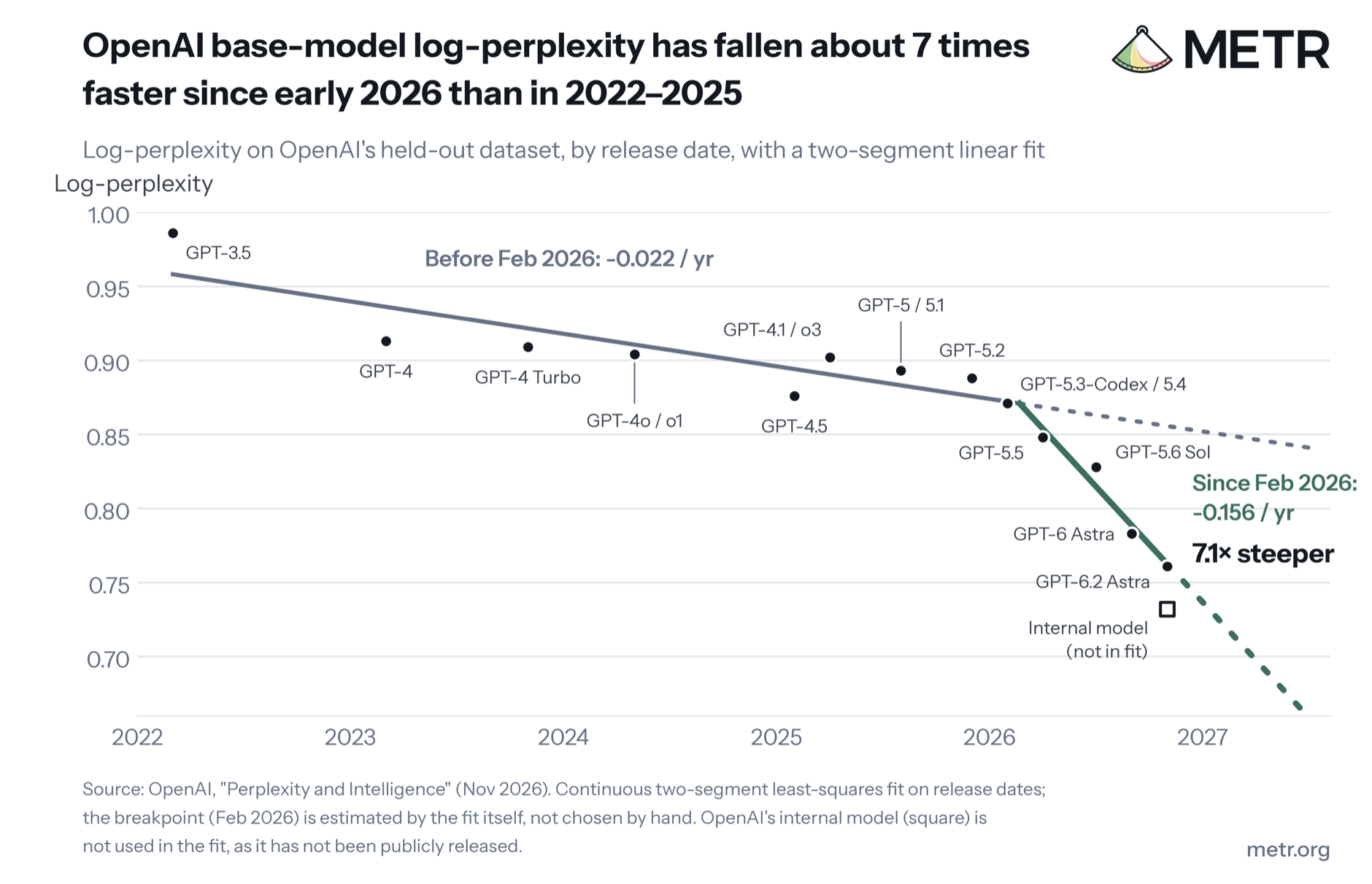
OpenAI points out that the primary way of measuring progress on this critical 'intelligence substrate' has remained stable for years: tracking model perplexity on held-out datasets. Perplexity measures a model's average ability to predict the next token; the lower the perplexity, the better the prediction. The chart presented in the article shows the evolution of OpenAI models on this metric since GPT-3.5.
The article emphasizes that the range of model capabilities roughly described by this single metric is astonishing. GPT-2, when it set a new state-of-the-art perplexity on an older dataset, was arguably the first model capable of consistently generating coherent paragraphs; GPT-3 possessed in-context learning; GPT-3.5, at a log-perplexity of about 0.99, could converse fluently and became the foundation of the original ChatGPT.
From GPT-4 to Below 0.8: Perplexity Thresholds and Emergent Capabilities
OpenAI discloses that GPT-4, at a log-perplexity of about 0.91, could effectively leverage chain-of-thought reasoning, which drove subsequent targeted elicitation of this capability and the creation of modern reasoning models. Today, when loss drops below 0.8, OpenAI sees transformative capabilities emerge in areas such as cybersecurity and mathematics. The article reiterates that whether these capabilities would appear upon reaching precise perplexity thresholds was not clear in advance; they can fundamentally be viewed as emergent latent capabilities arising from progress on this single metric.
OpenAI argues that as AI develops rapidly, the scope and methods for measuring downstream capabilities may change quickly. Evaluating GPT-2 and GPT-3 with most modern benchmarks is of little value, while the benchmarks of that era have largely saturated around GPT-4. By contrast, observing pre-training progress is likely to remain informative.
OpenAI notes that when model log-perplexity drops to about 0.76, breakthrough mathematical results begin to emerge.
- GPT-3.5 has a log-perplexity of about 0.99, GPT-4 about 0.91, and current models are below 0.8.
- OpenAI observes transformative capabilities in cybersecurity and mathematics, viewing them as emergent results of perplexity progress.
Acceleration Signals in Mathematics
OpenAI reveals that for over a year, it has used open mathematical problems as one way to evaluate models. When upgrading to a model with a log-perplexity of about 0.76, the model began producing breakthrough results. The article describes how, for many who have worked in mathematics and related fields, seeing solutions to long-pondered problems appear one after another in a Slack thread felt surreal.
OpenAI infers that similar sudden shifts are possible in deep learning research. Although the field relies more on experimentation, there is a long history of simple insights being overlooked for years. The article suggests that a similar wave of foundational pre-training progress could emerge as early as 2027.
AI Contributing to Its Own R&D and the Proposal for Shared Safety Speed Limits
OpenAI analyzes that a particular change in the pace of progress comes from AI's growing contribution to its own development. The most common discussion centers on AI augmenting and replacing human researchers at various stages of the development cycle, with the ultimate inflection point seen as 'full recursive self-improvement,' where the process is fully automated without human oversight. The article states that aside from the view that such a state should obviously be avoided to maintain human control, it believes this overall framework misses a key point: AI involvement in pre-training algorithm research could bring potential step changes.
OpenAI expects that AI will also significantly accelerate progress in alignment and monitoring, but believes such progress is unlikely to be fast enough to allow full acceleration of pre-training potential. On this basis, OpenAI proposes that frontier model developers work together to establish shared norms for evaluating such models and red-teaming safety cases before a model's first use, including shared transparency standards. The article further proposes setting common speed limits, based on perplexity and other measurements, that developers commit not to cross.
OpenAI expects that further transformative capabilities should be anticipated when entering the log-perplexity range of about 0.68 to 0.7.
- OpenAI believes AI involvement in pre-training algorithm research could bring step changes, but alignment and monitoring progress may not keep pace with pre-training acceleration.
- OpenAI proposes that frontier model developers jointly establish shared transparency standards and common perplexity-based speed limits.
Risks of Degrading Evaluation Awareness and Alignment Audits
OpenAI also warns that as perplexity continues to decline, further degradation of currently dominant forms of alignment auditing should be expected, along with further increases in evaluation and training awareness. The article notes that this means existing safety evaluation methods may become less effective as model capabilities improve.
Therefore, OpenAI advocates establishing shared evaluation norms and red-team safety case standards before a model's first use, and setting common speed limits based on measurements such as perplexity. The article argues that because new unexpected capabilities emerge primarily through compression progress, perplexity-rooted metrics can provide a shared benchmark for general intelligence, regardless of the degree of automation in the development process.
Impact
Industry Impact & Strategic Takeaways
OpenAI's release of internal pre-training metrics and its proposal for shared safety speed limits could drive a transparency race among frontier model developers and provide a comparable technical reference for the Asia-Pacific AI industry. If perplexity becomes a cross-lab shared benchmark, regional model developers and regulators will gain a relatively unified quantitative anchor for assessing model capabilities and safety risks, though whether the proposal can form industry consensus remains to be seen.
Frequently Asked Questions
What shared metric is OpenAI proposing?
+
OpenAI proposes establishing perplexity (equivalent to cross-entropy loss) as a shared metric for cross-model developer comparison and safety standards, and has released its internal log-perplexity measurements since GPT-3.5.
What key milestones does the data released by OpenAI show?
+
GPT-3.5 has a log-perplexity of about 0.99, GPT-4 about 0.91, and current models are below 0.8; at about 0.76, models begin producing breakthrough mathematical results, and OpenAI expects further transformative capabilities in the 0.68 to 0.7 range.
Why does OpenAI advocate establishing shared safety speed limits?
+
OpenAI believes new unexpected capabilities emerge primarily through pre-training compression progress, and that alignment audits may degrade as capabilities improve. Therefore, frontier model developers should establish shared evaluation norms, transparency standards, and common perplexity-based speed limits before a model's first use.
Primary Source & Attribution
OpenAI:官网动态(RSS · 排除企业/客户案例)
Perplexity and Intelligence
Related Deep Dives
METR Interprets OpenAI's Pretraining Loss Acceleration: Decline Rate Since Early 2026 Is About 7x Faster
64 pts · 5 min read
Perplexity Rolls Out GPT-6.2 Astra and GPT-6.2 Sol, Publishes WANDR Benchmark Results
66 pts · 3 min read
Perplexity CEO Congratulates Anthropic on Landmark IPO: Opus 5.5 Still Leads the Industry by a Clear Margin
75 pts · 5 min read

Researchers Say GPT-6.2 Astra Solved the 1808 Sketch Attribution Mystery in 22 Minutes
68 pts · 6 min read