Nvidia's New CEO Colette Kress Holds First Earnings Call: Tightening Spending and Drawing the Boundaries of Neocloud Backstops
After Jensen Huang's resignation, the board makes clear it does not intend to bring him back; Kress emphasizes employee commitment and business as usual while adjusting support terms for customer financing

Table of Contents (3)
Key Takeaways (TL;DR)
- 01Nvidia's new CEO Colette Kress chaired her first earnings call, signaling tighter financing support for customers and an end to the loose spending style of the Huang era.
- 02Board Chairman Harvey C. Jones explicitly said the board does not intend to bring Jensen Huang back and the company will not answer related questions; Kress denied that his departure would trigger a talent exodus.
- 03New terms in the earnings report show that neoclouds must first secure financing and complete data center construction before qualifying for Nvidia's purchase backstop, revealing the limits of the company's willingness to support customers.
Nvidia's new CEO Colette Kress, in her first earnings call since Jensen Huang's resignation, said the company will tighten spending and made clear that neoclouds will only receive purchase backstops once they have secured financing and their data centers are built and operational. Board Chairman Harvey C. Jones said the board does not intend to bring Huang back, and the company will not answer related questions.
Kress Sets the Tone at Her First Earnings Call: Spending Discipline Replaces 'Handshake' Financing
Nvidia's new CEO Colette Kress chaired her first earnings call after Jensen Huang's resignation, with the market watching to see whether she would continue her predecessor's style of supporting customers through loose financing. During her previous tenure as chief financial officer, Kress had repeatedly advised Huang to rein in spending on customer financing. Analysts believe that with Huang gone, Nvidia's financial support for customers may become more conservative, no longer relying on 'handshake' deals driven by personal relationships.
Kress noted on the call that Nvidia's agreements with suppliers run through the end of the decade, seeking to address concerns about supply chain stability. She also denied that Huang's departure would lead to an internal talent drain, saying employees are 'committed to spending their careers at Nvidia' and emphasizing that from a business perspective 'it's business as usual.' The remarks were aimed at shoring up investor confidence during the management transition.
Kress told investors: 'From a business perspective, it's business as usual.'
- Kress previously served as Nvidia's CFO and has long advocated restraining customer financing spending.
- Nvidia's agreements with suppliers run through the end of the decade, which Kress cited to address supply chain concerns.
- Kress said employees are committed to spending their careers at Nvidia and that business operations are proceeding as usual.
Board's Stance: No Plans to Bring Huang Back
Nvidia Board Chairman Harvey C. Jones stated explicitly on the call that the board does not intend to bring Jensen Huang back and that the company will not answer related questions. The statement was aimed at quelling speculation among some investors and industry observers that Huang might return. Unlike the 2023 OpenAI episode, in which Sam Altman was swiftly reinstated after being removed, Huang resigned voluntarily, and the board's position is firmer.
Although some employees support Huang's return, there has been no large-scale public wave of 'leaving with him.' Analysts believe the board's move is intended to draw clear governance boundaries and prevent the company's strategy from remaining tied to an individual. Kress, for her part, sought to direct market attention to business execution by emphasizing team commitment.
Neocloud Backstop Terms Tightened: Financing and Operational Launch Become Preconditions
New terms disclosed in the earnings report show that neoclouds will only receive Nvidia's purchase backstop after securing financing and completing data center construction and launching operations. The arrangement contrasts with the relationship-driven cooperation model of the Huang era and reveals the limits of Nvidia's willingness to support customers. Market observers believe the move is intended to reduce Nvidia's own financial risk while ensuring that computing supply matches actual demand.
There had been claims that deals between Huang and suppliers were sealed with a mere 'handshake' and no written contracts. Kress noted on the call that Nvidia's agreements with suppliers run through the end of the decade, indirectly responding to those claims. Analysts believe that regardless of whether 'handshake deals' existed, the direction of Nvidia's tightening backstop conditions is clear: a shift from relationship-driven to terms-driven.
The new terms make clear: neoclouds must first obtain financing and complete data center construction and launch operations before they can receive Nvidia's purchase backstop.
- Neoclouds must first secure financing and complete data center construction and launch operations before qualifying for Nvidia's purchase backstop.
- Kress said Nvidia's supplier agreements run through the end of the decade, responding to claims of 'handshake deals.'
- The new terms reflect a shift in Nvidia's customer support from relationship-driven to terms-driven.
Regulatory and Geopolitical Factors Compound
The U.S. Department of Commerce notified on November 16 that it would impose new restrictions on chip sales to Indonesia, Malaysia, Singapore, Thailand, and Brazil. In addition, global data centers that lease computing power to companies headquartered in China will need U.S. licenses. These measures could affect Nvidia's sales footprint; the company has raised its revenue growth forecast for next year to 75% but did not elaborate on regional impacts.
Singapore had previously accounted for a relatively high share of Nvidia's revenue, contributing $10.4 billion in 2025 as the second-largest geographic region. Nvidia later adjusted its reporting methodology, saying that most shipments associated with Singapore revenue were destined elsewhere. The market is watching the actual impact of the new restrictions on Nvidia's regional revenue structure, but the company did not provide further breakdown data.
Governance Risks and Market Focus
After Huang's resignation, Nvidia faces multiple governance and regulatory matters, including a U.S. Securities and Exchange Commission (SEC) investigation, a potential investigation by the California Attorney General, and upcoming congressional testimony by Huang and General Counsel Tim Teter. Reports also noted that Nvidia has not purchased full directors and officers liability insurance, and the company's own assets are not protected in related litigation.
The matters relate to allegations of circumventing bans on chip sales to China rather than primarily to personal lifestyle issues. Analysts believe Kress focused the earnings call on business operations and spending discipline to shift market attention from governance controversies to execution. However, the progress of regulatory investigations could still affect investors' assessment of Nvidia's risk exposure.
Reports noted that Nvidia has not purchased full directors and officers liability insurance, and the company's own assets are not protected in related litigation.
- Nvidia faces an SEC investigation, a potential California Attorney General investigation, and congressional testimony, among other matters.
- The company has not purchased full directors and officers liability insurance, and its own assets are not protected in related litigation.
- Kress focused the earnings call on business operations and spending discipline, playing down governance controversies.
Impact
Industry Impact & Strategic Takeaways
Nvidia's tightening of customer financing and neocloud backstop conditions after Huang's departure shows its willingness to support customers shifting from personal relationships to contractual constraints. For the Asia-Pacific AI industry, this means computing projects that rely on Nvidia's financial support will need to secure financing and launch operations earlier, and the pace of regional data center expansion could be affected. At the same time, new U.S. restrictions on chip sales to Singapore, Malaysia, Thailand, and other countries will prompt Asia-Pacific markets to reassess computing supply chain layouts and compliance costs.
Frequently Asked Questions
What did Nvidia's new CEO Colette Kress say at her first earnings call?
+
Kress said the company will tighten spending, denied that Huang's departure would cause a talent drain, emphasized employee commitment and business as usual, and noted that Nvidia's supplier agreements run through the end of the decade.
How have Nvidia's purchase backstop conditions for neoclouds changed?
+
The new terms require neoclouds to first secure financing and complete data center construction and launch operations before qualifying for Nvidia's purchase backstop, reflecting tighter limits on the company's willingness to support customers.
Does the board intend to bring Jensen Huang back to Nvidia?
+
Board Chairman Harvey C. Jones explicitly said the board does not intend to bring Huang back, and the company will not answer related questions.
Primary Source & Attribution
The Verge:AI(RSS)
Related Deep Dives

Nvidia Doubles Revenue but Stock Halves: How Jensen Huang's Resignation and Governance Probe Are Tearing Fundamentals Apart
82 pts · 6 min read
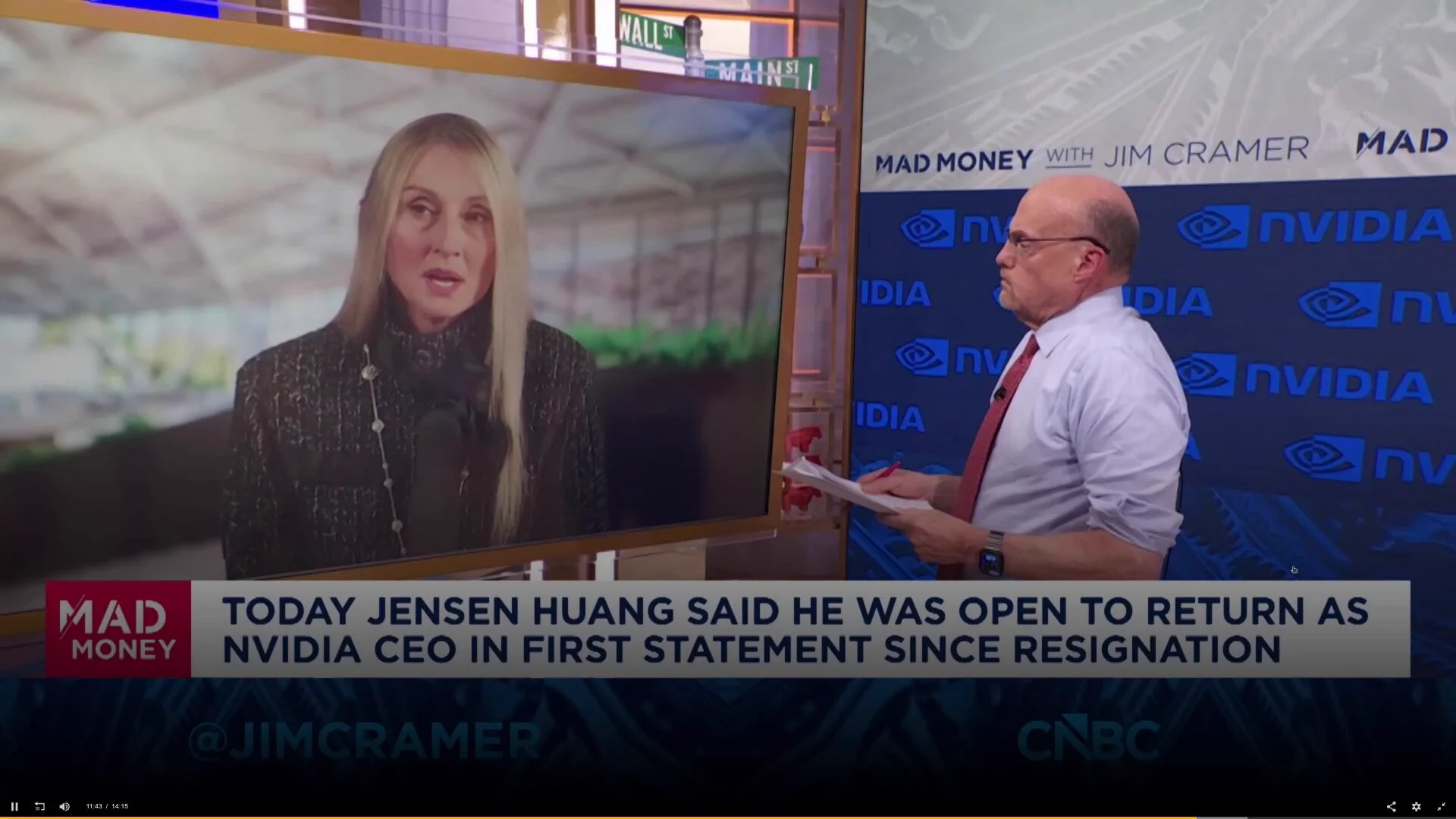
Nvidia Interim CEO Colette Kress: Board Has Decided Not to Reinstate Jensen Huang as CEO
89 pts · 5 min read
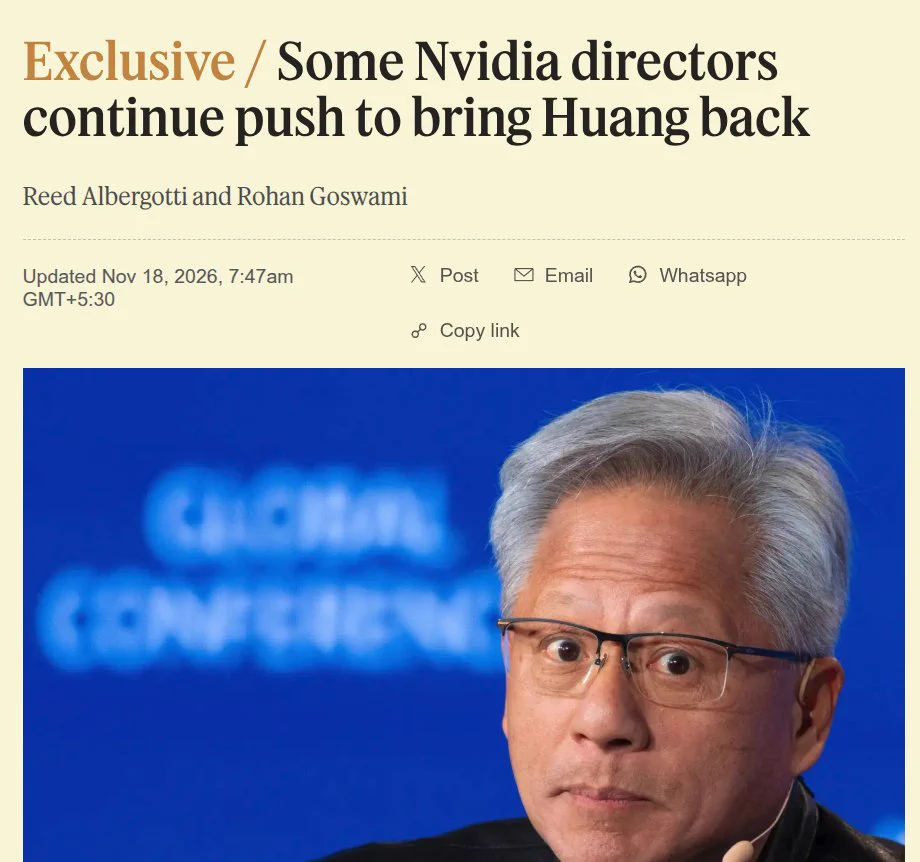
Semafor: Some Nvidia Directors Still Pushing for Jensen Huang's Return, Chairman Denies
83 pts · 4 min read

Nvidia Leadership Shakeup: Palmer Luckey Says Ousting Jensen Huang Plays Into China's Hands, 200,000 Sign Petition for Reinstatement
85 pts · 6 min read