Wiz Discloses Two Unauthenticated HTTP/2 RCE Vulnerabilities in NGINX, CVSS 9.2 Risk Affects 225 Million Websites
CVE-2026-123633 and CVE-2026-123007 are both memory safety flaws, one dormant for over a decade; F5 released fixes on November 18
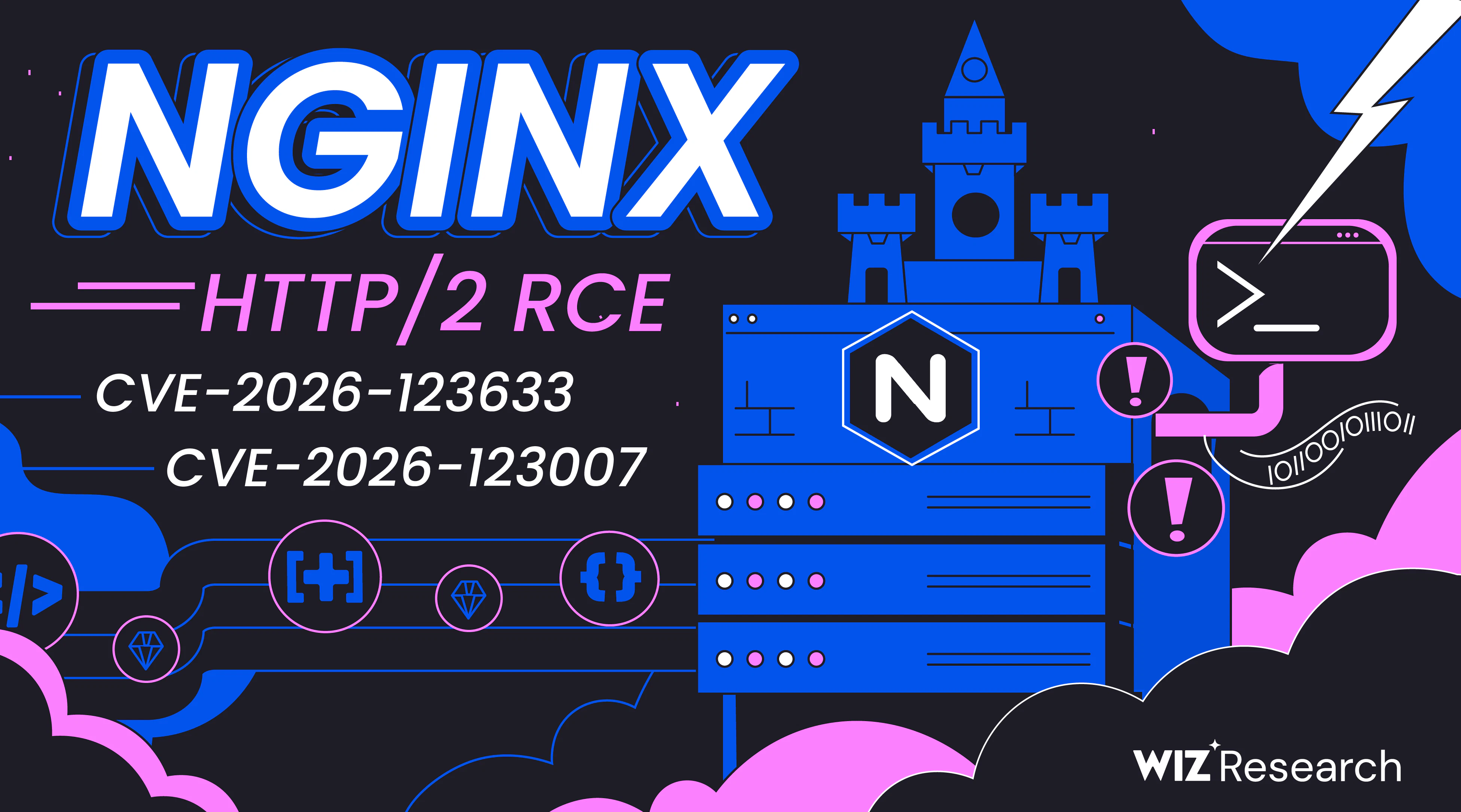
Table of Contents (3)
- 01NGINX's Front Door Breached: How Two Unauthenticated RCE Flaws Threaten 225 Million Websites
- 02AI Breaks Down the Discovery Barrier: How Wiz Atlas and Multi-Model Validation Shortened a Decade-Long Latency
- 03F5 Coordinated Disclosure Timeline: From October 21 Report to November 18 Fix
- Industry Impact & Strategic Takeaways
- Frequently Asked Questions
Key Takeaways (TL;DR)
- 01Wiz Research and four other teams independently discovered two critical RCE vulnerabilities in NGINX, CVE-2026-123633 and CVE-2026-123007, rated 9.2 under CVSS 4.0, both requiring HTTP/2 to be enabled.
- 02CVE-2026-123007 is an integer underflow flaw traceable to NGINX 1.9.5 from 2015, dormant for over a decade; CVE-2026-123633 is a use-after-free flaw that has existed for nearly six years.
- 03Wiz used its AI code scanning tool Wiz Atlas to find the vulnerabilities and leveraged Gemini 4 Carbon and ChatGPT 5.6 Sol to validate exploit impact, highlighting how AI is lowering the barrier to discovering long-hidden flaws.
Wiz Research, together with Ikotas Labs, Rapid7, and other teams, independently discovered two unauthenticated remote code execution vulnerabilities in NGINX, rated 9.2 under CVSS 4.0, both requiring HTTP/2 to be enabled. The flaws reside in NGINX itself, meaning websites may remain exposed even if application code is secure. F5 coordinated fixes and released a security update on November 18, 2026.
NGINX's Front Door Breached: How Two Unauthenticated RCE Flaws Threaten 225 Million Websites
NGINX is the world's most widely used open-source web server, powering more than 225 million websites and often serving as the reverse proxy in modern web architectures, handling HTTPS and routing incoming traffic to the correct application or API. Wiz Research notes that the disclosed CVE-2026-123633 and CVE-2026-123007 reside in NGINX itself, not in backend application code. This means that even if an organization's application-layer code is fully secure, websites and APIs may still be exposed to unauthenticated remote code execution risk as long as NGINX has HTTP/2 enabled.
Both vulnerabilities are rated Critical with a CVSS 4.0 score of 9.2. Successful exploitation could allow attackers to take control of affected NGINX servers, enabling arbitrary code execution, theft of sensitive data, website defacement, or service disruption. Because a single NGINX deployment often serves multiple applications, compromising one entry point can jeopardize multiple backend services. When testing CVE-2026-123007, Wiz even demonstrated code execution on an NGINX instance serving only ordinary static files, with no backend application or third-party modules.
NGINX powers more than 225 million websites; both vulnerabilities carry a CVSS 4.0 score of 9.2 and can be triggered remotely without authentication.
- Both vulnerabilities require HTTP/2 to be enabled on the affected NGINX server, a necessary condition for exploitation.
- CVE-2026-123007's impact traces back to NGINX 1.9.5, released in 2015.
- Wiz's testing showed that exploitation is possible with static file serving alone, without any backend application or third-party modules.
Memory Safety Flaws: Use-After-Free and Integer Underflow
Both vulnerabilities are fundamentally memory safety issues in how NGINX processes HTTP/2 traffic. CVE-2026-123633 is a use-after-free: memory associated with a connection is freed while a request still needs to access it, creating a window that attackers can manipulate. CVE-2026-123007 is an integer underflow flaw whose code roots trace back to NGINX 1.9.5 from 2015, meaning the defect lay hidden in the code for over a decade; the use-after-free flaw has also existed for nearly six years. Wiz emphasizes that such memory safety defects have historically been extremely difficult to find and exploit, typically requiring tracing subtle interactions between memory operations and multiple code paths.
AI Breaks Down the Discovery Barrier: How Wiz Atlas and Multi-Model Validation Shortened a Decade-Long Latency
Wiz Research used Wiz Atlas—the execution framework powering Wiz's AI code scanning solution—to discover both vulnerabilities, and leveraged Gemini 4 Carbon and ChatGPT 5.6 Sol to validate their impact, confirming that unauthenticated attackers could achieve code execution. Wiz states plainly in its report that AI is fundamentally dismantling a long-standing discovery barrier: in the past, the complexity of memory safety vulnerabilities itself constituted a practical barrier, but as AI models become better at tracing interactions between memory operations and multiple code paths, both researchers and attackers can uncover defects that have long lain dormant in internet infrastructure.
More alarming is that multiple independent research teams discovered the same batch of long-dormant vulnerabilities in PHP and NGINX almost simultaneously. The PHP2Shell vulnerability disclosed by Wiz last month and the Java4Shell disclosed by Calif yesterday fall into the same category. Wiz warns that as AI capabilities advance, each new generation of models may find more complex vulnerabilities previously beyond practical reach, and complexity can no longer serve as a barrier to discovery or exploitation. This changes not only which vulnerabilities can be found, but also the speed at which long-term risks translate into real threats.
Wiz says: complexity can no longer serve as a barrier to discovery or exploitation, and AI is changing the speed at which long-term risks become real threats.
- Wiz Atlas is the underlying execution framework of Wiz's AI code scanning solution, used to discover both NGINX vulnerabilities.
- Gemini 4 Carbon and ChatGPT 5.6 Sol were used to validate vulnerability impact, confirming unauthenticated code execution.
- PHP2Shell, Java4Shell, and the NGINX vulnerabilities all exhibit the characteristics of independent discovery by multiple teams and long-term dormancy.
From Disclosure to Exploitation: A Narrowing Window Puts New Pressure on Security Teams
Wiz notes that in the long run, faster vulnerability discovery and remediation will help harden the software the entire internet depends on; but in the short term, faster discovery and a shorter disclosure-to-exploitation window add workload to already stretched security teams. Translating released fixes into actual protection in production still requires substantial manual effort, including validating patches and coordinating rolling upgrades with service owners. Wiz recommends that organizations prioritize identifying deployments running affected versions and configurations, prioritize instances reachable by attackers, and apply mitigations while testing and rolling out patches.
F5 Coordinated Disclosure Timeline: From October 21 Report to November 18 Fix
According to the responsible disclosure timeline published by Wiz, on October 21, 2026, Wiz reported the HTTP/2 use-after-free vulnerability (later assigned CVE-2026-123633) to F5, along with a confirmed remote code execution exploit, an ASLR bypass, and suggested fixes; F5 confirmed that another research team had previously reported the same vulnerability. On November 10, F5 provided a patch for CVE-2026-123633 for review. On November 16, Wiz reported the second HTTP/2 vulnerability (later assigned CVE-2026-123007) to F5; on November 17, F5 confirmed that the second report matched CVE-2026-123007 and included it in the security release planned for November 18.
On November 18, F5 released the security update and coordinated public disclosure. Wiz recommends that organizations upgrade affected NGINX deployments to the latest version containing multiple security fixes; if immediate upgrade is not possible, HTTP/2 should be temporarily disabled. Wiz also reminds organizations to identify deployments running affected versions and configurations, prioritize instances reachable by attackers, and apply mitigations while patches are tested and rolled out.
F5 released fixes on November 18, 2026, just 28 days after Wiz first reported CVE-2026-123633.
- October 21, 2026: Wiz reports CVE-2026-123633 to F5, including an RCE exploit and ASLR bypass.
- November 16, 2026: Wiz reports CVE-2026-123007; on November 17, F5 confirms the match.
- November 18, 2026: F5 releases the security update and coordinates public disclosure.
Mitigation and Detection Guidance: Upgrade First, Temporarily Disable HTTP/2
Wiz's core mitigation path is to upgrade to the latest NGINX version, which includes multiple security fixes. If an upgrade cannot be completed immediately, HTTP/2 should be temporarily disabled to eliminate the attack surface. Organizations should also inventory all NGINX instances running affected versions with HTTP/2 enabled, prioritize remediation by attacker reachability, and deploy temporary mitigations during patch validation and rolling upgrades. Wiz emphasizes that the focus should be on how quickly exposure in production can be reduced, not merely on completing patch distribution.
Impact
Industry Impact & Strategic Takeaways
The implications of this incident for enterprise technology selection and security operations are direct and urgent: as a shared entry point, a single NGINX compromise can affect multiple backend services, and organizations should incorporate edge proxy memory safety into core risk management. AI-assisted vulnerability discovery is dramatically compressing the disclosure-to-exploitation window, requiring security teams to establish faster asset inventory, patch validation, and rolling upgrade processes. In the short term, prioritizing NGINX upgrades or disabling HTTP/2 is the most effective way to reduce exposure; in the long term, the era of relying on complexity as a security barrier is coming to an end.
Frequently Asked Questions
Which versions of NGINX are affected by these two vulnerabilities?
+
CVE-2026-123007's impact traces back to NGINX 1.9.5, released in 2015; CVE-2026-123633 has existed for nearly six years. Both require HTTP/2 to be enabled on the affected server. F5 released a security update containing fixes on November 18, 2026, and upgrading to the latest version is recommended.
What should be done if NGINX cannot be upgraded immediately?
+
Wiz recommends temporarily disabling HTTP/2 to eliminate the attack surface, while identifying all deployments running affected versions with HTTP/2 enabled, prioritizing instances reachable by attackers, and applying temporary mitigations during patch testing and rollout.
Why is AI said to lower the barrier to vulnerability discovery?
+
Wiz used Wiz Atlas to discover the vulnerabilities and leveraged Gemini 4 Carbon and ChatGPT 5.6 Sol to validate impact. AI models are better at tracing interactions between memory operations and multiple code paths, making long-dormant complex memory safety defects easier for researchers and attackers to find, and complexity no longer constitutes a practical barrier.
Primary Source & Attribution
Wiz:Research(安全研究)
Unauthenticated Remote Code Execution in NGINX: CVE-2026-123633 and CVE-2026-123007
Related Deep Dives

Researcher Plants 2 Million Canaries in the AI Supply Chain, Exposing Prompt and Credential Leaks
78 pts · 5 min read

OpenClaw and Hugging Face Release ShellBench Real-World Task Benchmark; Top Model Achieves Only ~60% Completion
66 pts · 5 min read

OpenBMB Releases EVIL Benchmark: 10 Frontier Models Including GPT-4o Score Below 75% Safety Rate on Illegal Scenarios
65 pts · 5 min read
AISI Red-Team Paper: Attack Strategy Choice Distorts LLM Monitor Evaluations
60 pts · 5 min read