Tencent Hunyuan Hy4 Open Weights: 770B Native Multimodal MoE Flagship Officially Open-Sourced
770B total parameters, 49B activated, 1M context support, with System Card and GGUF quantized versions released alongside; AMA this Friday on r/LocalLLaMA
Table of Contents (3)
Key Takeaways (TL;DR)
- 01Tencent Hunyuan has open-sourced Hy4 weights; the model is a native multimodal MoE architecture with 770B total parameters, 49B activated, and 1M context support.
- 02The Hy4 System Card was released alongside, containing a comprehensive safety evaluation report, with weights and GGUF quantized downloads available on GitHub and Hugging Face.
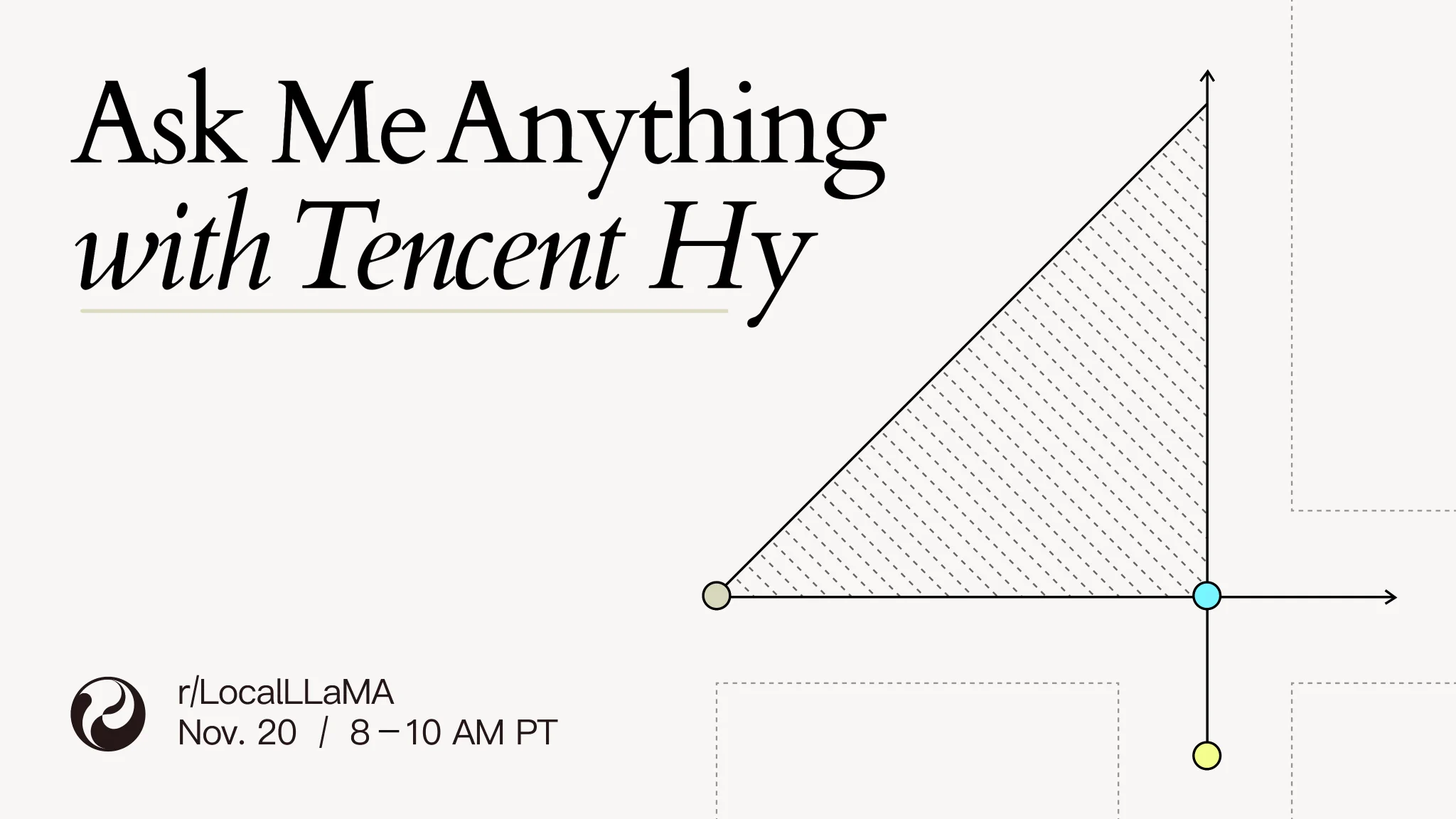
- 03The team will hold an AMA this Friday from 8–10 AM PT on r/LocalLLaMA to directly answer developer questions about the Hy series models.
Tencent Hunyuan announced on November 20, 2026, the open-weight release of Hy4, positioned as its native multimodal flagship MoE architecture with 770B total parameters, 49B activated parameters, and support for a 1M ultra-long context. The team simultaneously published the Hy4 System Card including a comprehensive safety evaluation report, and made weights and GGUF downloads available on GitHub and Hugging Face. The team will hold an AMA this Friday from 8–10 AM PT on r/LocalLLaMA to engage directly with developers.
Hy4 Specs Breakdown: A 770B Total / 49B Activated MoE Flagship
The Hy4 released by Tencent Hunyuan is not a small experimental model but its native multimodal flagship product. According to the official tweet, Hy4 adopts a Mixture-of-Experts (MoE) architecture with 770B total parameters but activates only 49B parameters per inference. This design significantly reduces the compute cost of a single inference while maintaining the knowledge capacity of a large model, making local deployment and high-concurrency serving feasible.
More noteworthy is its 1M context window. In scenarios such as long-document understanding, multi-turn dialogue, and repository-level code analysis, million-token context has become a standard capability for flagship models. Hy4 combines this capability with native multimodality (text, image, video, and 3D generation), meaning developers can process long cross-modal input sequences with a single model without relying on stitching together multiple specialized models.
770B total parameters / 49B activated parameters / 1M context—Hy4 balances model capacity and inference efficiency with a sparse MoE architecture.
- 770B total parameters, 49B activated parameters, sparse MoE architecture
- Supports a 1M token context window
- Native multimodality: covers text, image, video, and 3D generation
- Officially positioned as Tencent Hunyuan's flagship foundation model
Co-Design of Native Multimodality and MoE
Unlike multimodal approaches that bolt on a vision encoder after the fact, Hy4 is officially described as a 'native multimodal' model. This means the model fuses multimodal data during pretraining, with all modalities sharing a unified representation space. Combined with the MoE architecture, different experts can specialize for different modalities or task types, improving inference efficiency on multimodal tasks while maintaining the total parameter scale.
For enterprise technology selection, the value of a native multimodal MoE lies in reducing system complexity: a single model can cover text generation, image understanding, video analysis, and 3D content generation, cutting the latency and operational overhead introduced by multi-model orchestration.
Open-Source Deliverables Overview: Weights, GGUF, and System Card Safety Evaluation
Tencent Hunyuan is releasing not just model weights but a complete developer package. The official tweet lists four key entry points: the GitHub repository, the Hugging Face weights page, the GGUF quantized version download link, and license information. The provision of GGUF format is particularly noteworthy—it means Hy4 can run directly in local inference frameworks such as llama.cpp, lowering the deployment barrier for individual developers and small teams.
At the same time, the team released the Hy4 System Card, which includes a comprehensive safety evaluation report. Amid increasingly fierce competition among open-source models, safety evaluation transparency is becoming a standard part of model releases. System Cards typically disclose test results on dimensions such as bias, toxicity, jailbreak resistance, and cybersecurity, helping downstream developers make more informed decisions on compliance and risk management.
The simultaneous release of GGUF quantized versions and the System Card shows that Tencent Hunyuan's open-source strategy balances both local deployment convenience and safety transparency.
- GitHub repository: provides model code and usage documentation
- Hugging Face weights: official original weight downloads
- GGUF quantized versions: compatible with local inference frameworks such as llama.cpp
- Hy4 System Card: includes a comprehensive safety evaluation report
- License: official separate license link provided
Connecting GGUF with the Local Deployment Ecosystem
GGUF is a model format widely adopted in the llama.cpp ecosystem, supporting CPU/GPU hybrid inference and multiple quantization precisions. Hy4's GGUF download means developers can run this 770B-total-parameter MoE model in quantized form on consumer-grade hardware—although the actual runnable quantization levels and hardware configurations still need to be checked against official documentation, this move significantly expands the model's reach.
For enterprise intranet deployment scenarios, the GGUF version also makes it easy to quickly validate model capabilities in isolated environments before deciding whether to invest resources in full-precision deployment.
Community Engagement and Open-Source Competition: Signals from the AMA
The Tencent Hunyuan team announced it will hold an AMA (Ask Me Anything) this Friday from 8–10 AM PT on Reddit's r/LocalLLaMA. r/LocalLLaMA is a core gathering place for local large-model deployment enthusiasts and developers worldwide; choosing to hold the AMA there indicates Tencent Hunyuan wants to reach technical users in the open-source community directly, not just enterprise customers.
From a competitive standpoint, Hy4's open-weight release continues the open-source large-model arms race of 2026. The combination of 770B total parameters, native multimodality, and 1M context in a single open-source model clearly targets top international open-source flagships. Through the combined delivery of weights, GGUF, and a System Card, Tencent Hunyuan is trying to build trust and usage habits within the developer ecosystem.
Holding an AMA on r/LocalLLaMA is a clear signal from Tencent Hunyuan to the local deployment community: Hy4 is not only for cloud APIs but also takes open-source localization scenarios seriously.
- AMA time: this Friday, 8–10 AM PT
- Platform: Reddit r/LocalLLaMA
- Topic: Hy series model questions and direct discussion
- Tweet engagement: 388 likes, 48 reposts, 16 replies (early post-release)
Practical Impact on Developer Technology Selection
For teams evaluating open-source flagship models, Hy4 offers a new candidate. Its MoE architecture means inference cost is tied to activated parameters (49B) rather than total parameters (770B), which is fundamentally different from dense models in cost estimation. Developers should focus on actual VRAM usage after GGUF quantization, inference latency at 1M context, and the usability of the native multimodal interface.
The AMA is an opportunity to obtain this first-hand information. Developers are advised to focus on quantization accuracy loss, long-context performance degradation, commercial-use terms in the license, and officially recommended inference framework configurations.
Impact
Industry Impact & Strategic Takeaways
Hy4's open-weight release will intensify competition among open-source flagship models, especially in the native multimodal and ultra-long-context tracks. For enterprises, the 770B/49B MoE design offers a flagship-grade option with controllable costs, and the GGUF version lowers the barrier to local validation; for developers, the System Card and AMA provide windows to evaluate safety and engineering details. Technology selection should focus on verifying actual post-quantization performance and license terms rather than just parameter scale.
Frequently Asked Questions
Is Tencent Hunyuan Hy4 an open-source model? Can it be used commercially?
+
Hy4 has open model weights, with official GitHub, Hugging Face, and GGUF download links, plus a separate license link. Whether commercial use is permitted depends on the specific terms of that license; it is recommended to read the official License carefully before deployment.
What do Hy4's 770B total parameters and 49B activated parameters mean?
+
Hy4 uses a Mixture-of-Experts (MoE) architecture. The 770B total parameters represent the model's overall stored knowledge capacity, while only 49B parameters are activated per inference. This sparse activation design significantly reduces the compute cost of a single inference while maintaining large-model capabilities.
Can ordinary developers run Hy4 locally?
+
The team provides GGUF quantized versions compatible with local inference frameworks such as llama.cpp, theoretically allowing quantized execution on consumer-grade or workstation hardware. However, with 770B total parameters, the actual runnable quantization levels and hardware configurations should be checked against official documentation and community practice.
Primary Source & Attribution
X:腾讯混元 (@TencentHunyuan)
Today, we’re releasing the open weights for Hy4.
Related Deep Dives
Tencent Hunyuan Hy4 flash Opens Weights, Releases FP8 and Base Versions
67 pts · 4 min read
Tencent Hunyuan Hy4 flash Opens Weights, Reddit AMA on November 20 to Explain Model Build
71 pts · 5 min read
Tencent's Open-Source Hy4 Flash Lands on Fireworks Serverless, Targeting Low-Cost Specialized Tasks
75 pts · 5 min read

OpenAI Details Frontier AI Risk Management: How a Four-Layer Defense System Spans Training to Deployment
67 pts · 5 min read