MiniMax Launches H3 Family Series: 1,472 Derivative Models and Over 148 Million Downloads in 100 Days of Open Source
Expanding from a single H3 model to a full product matrix covering quality, speed, and cost, with vertical extension models launched in partnership with fal, Suno, HeyGen, and others.

Table of Contents (3)
Key Takeaways (TL;DR)
- 01MiniMax has expanded the single H3 model into the H3 Family, with flagship models covering 2K quality, high-speed generation, and low-cost exploration.
- 02Within 100 days of open-sourcing H3, 1,472 derivative models have been created, with total downloads exceeding 148 million—over 17 per second on average.
- 03Platforms such as fal, Suno, HeyGen, and Pika, as well as companies like Nvidia, Tencent, and Alibaba, have retrained vertical derivative models based on H3.
MiniMax has released the H3 Family series, including flagship models H3, H3-Highspeed, H3-Lite, and H3-Image. Within 100 days of open-sourcing H3, 1,472 derivative models have been created, with total downloads exceeding 148 million, and licensing partnerships have been established with more than ten leading companies worldwide.
H3 Family Flagship Matrix: Tiered by Quality, Speed, and Cost
MiniMax has officially launched the H3 Family series, expanding the previously open-sourced H3 into a product matrix covering diverse creative needs. The flagship models include the quality-first MiniMax H3, H3-Highspeed for large-scale commercial creation, H3-Lite for low-cost exploration, and the image-oriented H3-Image and H3-Image Highspeed. The company says the flagship models and some extension models are directly available on the MiniMax Open Platform and MiniMax Code.
In terms of pricing and specifications, H3 supports output resolutions of 2K and 768P, starting at ¥0.5 per second; H3-Highspeed focuses on 768P/480P, starting at ¥0.26 per second, generating a 5-second video in about 11 seconds on average; H3-Lite is priced even lower, starting at ¥0.16 per second. The image model H3-Image is priced at ¥25 per million tokens, and the Highspeed version at ¥50 per million tokens, with the latter generating a 4K image in under 10 seconds at the fastest.
In 100 days of open source, developers turned 1 H3 into 1,472 derivative models, with total downloads exceeding 148 million—over 17 per second on average.
- H3: 2K/768P output, starting at ¥0.5 per second, supports precise instruction-based local adjustments.
- H3-Highspeed: generates a 5-second video in about 11 seconds on average, and a 15-second video in at most 1 minute.
- H3-Lite: generates a 5-second 768P video in about 8 seconds, at a cost of about ¥1.3.
Speed and Instruction-Following Positioning of the Image Model
H3-Image is officially positioned as the image model with the strongest instruction-following capability among open-source models, supporting up to 16 reference images and emphasizing rich detail and realism. MiniMax reports that compared with mainstream models on the market, its speed reaches 150% to 200% and its price is 50% to 70%. The Highspeed mode further compresses 4K image generation time to under 10 seconds, about 3 to 4 times faster than mainstream models in the same tier.
100-Day Open-Source Ecosystem: 1,472 Derivative Models and Global Licensing Partnerships
MiniMax reports that within 100 days of open-sourcing H3, global developers have retrained 1,472 derivative models based on it, corresponding to 1,472 specific needs and use cases, with total downloads exceeding 148 million. Participants include tech companies such as Nvidia, Tencent, and Alibaba; AI application and platform companies such as fal, Suno, HeyGen, Pika, and Creatify; and university research teams from MIT, the National University of Singapore, and Hong Kong Polytechnic University.
On the commercialization front, MiniMax says more than ten leading companies worldwide have entered into licensing partnerships with it, covering e-commerce, gaming, film and television, animation, short dramas, and industrial design. This ecosystem data indicates that open-source models are becoming the foundational layer of multimodal creation toolchains, and the focus of competition among model vendors is shifting from single-model performance to developer community size and vertical adaptation capabilities.
More than ten leading companies worldwide have entered into licensing partnerships with MiniMax to upgrade their productivity foundations in e-commerce, gaming, film and television, animation, short dramas, and industrial design.
- Derivative models cover vertical scenarios such as digital humans, film and television production, e-commerce advertising, and music videos.
- Partners include fal, Suno, HeyGen, Pika, Creatify, RunningHub, Utopai Studios, and others.
- University research teams come from MIT, the National University of Singapore, Hong Kong Polytechnic University, and others.
Differentiated Paths of Third-Party Extension Models
Beyond the flagship models, the H3 Family also includes several extension models developed by partners. fal's H3 Max can generate a 5-second 768P video in under 3 seconds, and H3-Max Turbo is twice as fast; Suno's H3 Move is designed specifically for music videos, generating lip-synced videos that match the song's style and lyrics; HeyGen's Video 1 focuses on digital humans and e-commerce scenarios, generating a complete video with visuals, dialogue, and sound effects in one go, up to 30 seconds long.
In addition, Pika's H3 Flex supports 6-step generation and fine adjustment of camera movement and sound effects; LightX2V/ModelTC's MiniMax-H3 Turbo compresses generation to 4 or 8 steps and supports local deployment; Akatz Labs' Character Swap V1.5 specifically enhances the ability to locally replace designated characters in videos. All these models can be accessed via the MiniMax Open Platform.
From Model Release to Ecosystem Operations: MiniMax's Open-Source Strategy Shift
The launch of the H3 Family marks a shift in MiniMax's open-source strategy from opening a single model to systematic ecosystem operations. The company states that it will continue to open-source models, improve tools, and continuously recruit derivative models based on H3 to join the H3 Family, with partnerships open to developers and companies worldwide, covering video generation application scenarios such as digital humans, film and television, e-commerce, and gaming.
For the Asia-Pacific AI industry, this model provides a sample for observing the commercialization of open-source multimodal models: open-sourcing the base model attracts developers, partners complete scenario adaptation for vertical extension models, and the platform obtains commercial returns through open platform access and licensing partnerships. Its effectiveness will depend on the continued activity of derivative models and the willingness of commercial customers to pay.
MiniMax says it will continue to open-source models and improve tools so that the prosperity of the multimodal open-source ecosystem benefits more people.
- MiniMax has set up an H3 Family collection page to showcase practice cases based on H3.
- Partnership recruitment is open to developers worldwide, covering scenarios such as digital humans, film and television, e-commerce, and gaming.
- The company emphasizes it will continue to open-source and support developers in creating further on the H3 series.
Impact
Industry Impact & Strategic Takeaways
The launch of the H3 Family shows that competition in open-source multimodal models has extended from parameters and image quality to developer ecosystems and vertical adaptation. For the Asia-Pacific market, where content industries such as e-commerce, short dramas, and gaming are dense, low-cost, high-speed video generation models have direct productivity value. MiniMax's approach of binding global platform companies through licensing partnerships may provide a commercialization reference for other open-source model vendors, but the stickiness of its ecosystem still needs to be observed through the long-term activity of derivative models.
Frequently Asked Questions
What models are included in the MiniMax H3 Family?
+
The H3 Family includes flagship models MiniMax H3, H3-Highspeed, H3-Lite, H3-Image, and H3-Image Highspeed, as well as several extension models developed by partners such as fal, Suno, HeyGen, Pika, and Creatify.
What are the ecosystem metrics for H3's first 100 days of open source?
+
MiniMax reports that within 100 days of open-sourcing H3, 1,472 derivative models have been created, with total downloads exceeding 148 million—over 17 per second on average—and licensing partnerships with more than ten leading companies worldwide.
How do the positioning of H3-Lite and H3-Highspeed differ?
+
H3-Highspeed targets daily and large-scale commercial creation, balancing quality, speed, and stability; H3-Lite focuses on lower cost, suitable for early-stage creative testing and mass production of repetitive materials.
Primary Source & Attribution
公众号:MiniMax(稀宇科技)
Related Deep Dives
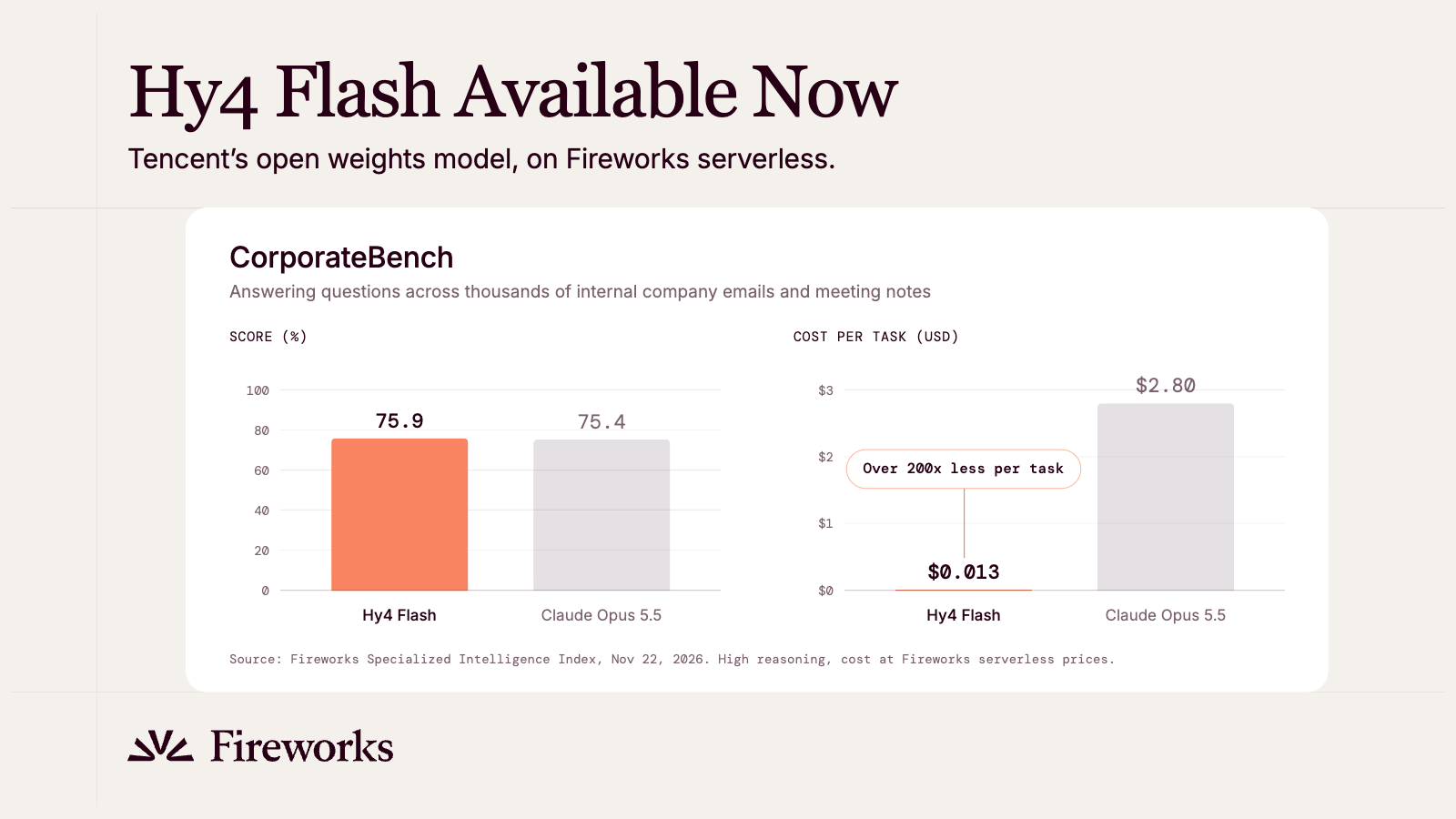
Tencent's Open-Source Hy4 Flash Lands on Fireworks Serverless, Targeting Low-Cost Specialized Tasks
75 pts · 5 min read

MiniMax Internal Model MIM Achieves Multiple Practical Cryptanalytic Attacks and Open-Sources Verification Traces
73 pts · 5 min read

OpenAI Launches GPT-6.2 Astra and GPT-6.2 Sol, Setting New Professional Task Benchmarks at Lower Token Cost
86 pts · 5 min read
OpenAI Releases GPT-6.2 Astra and Sol: Topping the Value Chart, But Mixed Reviews and the Battle for Anthropic's Strongest Model
83 pts · 7 min read